Showing posts with label New York City. Show all posts

Sunday, July 13, 2014

Just when did everything get so difficult #237, or, why I get so cranky...

It's another disgustingly beautiful morning here in the southern part of Vermont.

It could have easily been an enjoyable morning, but.... I made the mistake of checking Facebook. Specifically, I made the mistake of checking our Community Radio Station's Facebook page. (I'm one of the moderators.) It had been updated to a newer improved version. Which means that it is broken and isn't working.

Weeds in the garden

I check in on Geo's page, and decide to leave a comment.
Nope, won't do it.

I was using the browser everyone raves about. It was recently improved. Since the last update, I can't stop videos from automatically streaming. Videos that are stopped start by themselves. Videos that are stopped (and the few which never started) leak sound a few annoying bits at a time. I keep several pages open at once. Which page has the problem? I also have the page set so that it is magnified and easier to read. Since the update, that doesn't work properly either. The browser that is so much better doesn't have magnification ability - it is possible thanks to an add-on. Which doesn't work with the latest updated browser.

I thought I had 'joined' Geo's train ride - but that must have been on another browser, the one everyone says I shouldn't use, you know, the one I use most of the time. Simple matter, I'll just join his page. Except the browser won't do it. I receive instruction from the program. Cookies. Yeah, I like cookies. Oh, those. I check - the kind to which the instructions refer are enabled. Still no go. Check 'Privacy' settings - nope that wasn't it either. Maybe it isn't the browser, maybe it's a setting with the anti-virus anti-invasive threat anti-what-have-you-got program. Nope, not that one either. What about the program from the cable company that provides my high speed internet connection for a hefty fee? No, not that one. How about a setting in the Googlesphere?

bug on a Shasta daisy bud
After awhile I finally give up, and go to the browser I usually use. I don't see myself listed as a member of Geo's page on that browser either. So I join up. All I have to do is put in my password. I remember it, everything works fine. Until I see my old avatar and decide to update it. I upload a new one. It is rejected. I browse for a particular file folder with a picture I think might be fun to use. The "browse" function shows a file folder arrangement that was changed two years ago. That function used to work fine - until it was improved in an update.

the bindweed gets a visitor
A memory crosses my now grumpy brain. I bought an out of the box computer back around, oh, was it 2,000 or 2,001? It came with a lovely little program called EZ CD Creator. I could make a CD with such little effort. I could make CD covers and inserts that automatically listed all of the contents on the disc I'd just made. It had a great little graphics program that allowed text or other images to be superimposed over pictures. There were lots of fonts for the text, which could be tilted, placed in circular form, oh, there were all kinds of things that could be done. It was all so, so, well - - - so EZ. But then my Internet and Phone Service Provider made dsl available and I was sorely tempted by the newer, the faster, the improved. Which wouldn't work. The computer software refused to load the proper drivers. After months of frustrations, after months of paying for a service I couldn't use, I found the cause in an online forum. It was a peculiarity of the version of Windows which came loaded on the computer. I purchased the newer (expensive) Windows XP, and spent a portion of eternity in purgatory while the update took place. The dsl worked without my doing anything. I entered high speed Nirvana. I lived in a heightened state of awareness, a state of exultation, a state of delightenment. Until I tired to burn a CD. My great little free with the computer EZ CD Creator wouldn't work with the upgraded Windows XP. Okay.... I bought the new updated (pricey) EZ CD Creator. Except all it would do was burn the CD. It would no longer automatically list the contents of my newly burned CD. When I went to type it all out, I discovered that there was only one font I could use, an ugly one at that. The graphics part of the program was gone. It turned out that EZ CD Creator had been purchased by another company, and I had bought a "basic" version of the new improved EZ CD creator. The functions I loved were still available - if I purchased their expensive CD cover creation program. And their separate easy to use font pack. And for those to work I should probably purchase an upgraded version of their basic program. The only improvement I could detect was to the manufacturer's bottom line. Somewhere, Steve Jobs must have been smiling.

One of my old computers, cobbled together from spare parts in what a friend called "open architecture". 
I remember renting a run down little studio apartment in Greenwich Village in 1975. When I first saw it, I was happy enough - it was better than all the other average run down little hovels I had seen. The previous tenant had lived there for a very long, long time. The place was a mess and was being fixed up. It was basically a studio of about 11 feet in width, except that there was a squared archway between the main part of the room and a 9 feet in width section for the kitchen area and bathroom. Two large French doors hung in the archway; every single pane of glass broken. I went right back to the realtor and said I wanted to take it. She called the landlord. Another relator on the phone with the landlord also wanted the place. My realtor held up two fingers. I nodded. "Well, my client will put up two moths security." I got the place. I could have it as soon as they finished fixing it up. I asked that the French Doors be kept, offering to pay for the replacement of the glass sections myself. I waited and waited. They never seemed to finish fixing up the place. Weeks went by. Finally, all that remained was sweeping up from the fixing up. There was another week of waiting. I requested a change in my already paid rent due date, and said that I'd be happy to sweep the place out. I was given the go ahead to move in, which I did one night after work. The French Doors were gone. The old ceramic sink was gone, replaced with a cut down aluminum fish monger's sink barely propped up with a wooden structure of some sort. There was a new gas stove, and a new refrigerator. The place had been painted, and - what was the landlord's word?- "improved". I plugged everything in, and went to the nearby grocery store to get provisions. The store was in its last day of a really good sale on meat. I bought a fair amount of it, putting what I wasn't going to use for dinner into the freezer. Next morning I trooped off to work. When I got home after my 8 (+ lunchtime) hours of toiling in the fields of Mammon, I sat down and turned on the tv to watch the news. It blew up. I turned on the radio. It didn't work either. I opened the fridge - it wasn't working. Everything in it was spoiled. I pondered the situation. The lights worked, but nothing else would. The Village was one of the first areas in New York City to be wired for electricity. In those days, there was only direct current. Lights would work on direct current....  Sure enough, the place hadn't been updated to alternating current. It had, you see, been "improved".

'Japanese' beetles have arrived to destroy the roses.
 
One can almost hear the munching...
Post Script - There are a lot of graphic files on my computer, ordered in an arcane manner of my preference. I used to be able to just tell blogger the file name I wanted to upload. Older files had underlines or dashes so no blank spaces existed in the name, as that would confuse the programs. That got fixed. Except now if there is a dash or an underline in a file name, the upload programs can't seem to find the file - I have to go to the appropriate folder and click on the image. Blogger itself misbehaves; I added a caption to the above photo and it suddenly moved ahead of the previous picture and changed to a very large size. Because I have the page magnified, the options for managing the size and placement of the photo become hidden behind another button and are inaccessible until I go back to the size blogger seems to think is more appropriate. I "preview" the page so I can see how it will look when published. A banner appears to warn me that programs are in use which may be unsafe, so the program has thoughtfully blocked them for me. It has to be clicked off. It's been this way ever since they made a number of "improvements".


Sunday, April 27, 2014

The green light at the end of the dock...

Last week one of those anniversaries that media outlets love to note occurred. Network tv stations, as well as various internet outlets, showed about 30 seconds worth of fuzzy film footage before moving on to something else. But that little bit of 'soft news' gave me pause. The warm glow of nostalgia, as fuzzy as the images, began to flow. Yes, I had been there. I had seen. I had experienced. I had lived.

You see, on April the 23rd, it was 50 years to the day since the New York World's Fair of 1964 - 1965 opened. A couple of times, it was referred to as "The World of Tomorrow". That phrase was, we were told, the slogan of the fair and was solemnly intoned while a picture of the Unisphere was shown. Except it wasn't. That  was the slogan of the 1939 - 1940 fair, held at the same location. In fact, the symbols of that earlier fair, the Trylon and Perisphere, were in the same exact spot where the Unisphere was built. The Unisphere was the largest model of our planet ever constructed, made out of the finest U.S. Steel. It was at the center point of the fair in a reflecting pool, surrounded by fountain jets of water which reached upward to the sky mirroring our hopes and ambitions for "Peace Through Understanding",  the fair's actual motto.

I knew all of this for the simple reason that I was 13 years old and desperate to escape (even for a few paltry hours) from my ordinary little home town in the southern part of New Jersey. This wasn't just a World's Fair, it was a New York World's Fair. Baghdad on the subway. Visions of delightful (but unspecified) decadence floated before my mental eyes like those conjured by the Devil to tempt the Christ during His sojourn in the desert. I knew this for a fact; I had seen the movie.

I managed to get to the fair twice. If memory isn't playing a trick or two to embroider the sense of stultification I was experiencing in my hometown, there was an excursion with the Methodist Youth Fellowship, and a trip with the Boy Scouts. I was that desperate to go. It is a wonder I remember that part at all. I remember the long bus journey there. I remember walking down a seemingly endless boardwalk, through an awning of stylized wings that seemed poised to take off . Without warning, rising from a sea of color, it loomed in front of me, a vision, a dream, a temptation - the Unisphere. I had arrived.


There had been months spent in expectant, torturous, exquisite waiting. My father allowed that he hated New York and would get nowhere near the place, but that as a teenager he had gone to the 1939 fair and loved it. I had already found the jig saw puzzle he had purchased as a souvenir. It was a map of the fair, and was missing pieces. I had still put it together, and fallen in love with the Trylon and Perisphere symbols. After a bit of outright begging, he allowed me to use his 8mm Bell and Howell camera to take movies while I was there. The camera was a little finicky as to settings in strong daylight, so he also allowed me to use his light meter. Weeks later I would discover that the light meter was no longer working properly and the footage of the fair was horribly overexposed. For the 1965 edition, he allowed the use of his new super 8 movie camera, after the requisite repeated begging of course. One of these days I must get those put into digital format. I didn't take still pictures, but I did take slides  - with my new Instamatic camera, purchased at Mr. Duper's Hobby Shop on my town's Main Street. The Hobby Shop was next to the storefront that was the Greek's diner where I used to purchase my cherry cokes after the soda fountain at the Rexall was removed. If the place had a real name, I never knew it. Everyone called it "the Greek's", a bow to the ethnicity of its proprietor. It was on such an excursion that I'd noticed the arrival of the new Kodak camera on display in the Hobby Shop window, and began to save my pennies.


When the Kodak pavilion was included in the 50th anniversary news reports, only one mentioned that it displayed the largest color photos made up to that date. No one mentioned that the rest of the building's roof was a futuristic moonscape - with spots which had placards which noted them as being perfect for taking pictures of the fair. Which brings up one other little matter, best illustrated with this commercial:


The reason I wanted to post that is very simple - it is in black and white. So was television then. In fact, it was at the fair's RCA pavilion that color tv was first demonstrated for eager dreamy eyed buyers. (Movies had been black and white, too, with color saved for big budget spectaculars and musicals.) Quite a bit of what has turned up documenting the fair is in black and white, which does it a great disservice. It was the early 60's, the world had become color, and the circus had come to town.

One of the exhibits which fascinated me the most was the IBM pavilion. Floating above what seemed like a sea of metal treetops was a giant egg. I've never been sure what that was supposed to represent, or what meaning was attached to it. Perhaps it was an expression of the Dadaist sensibility inherent in the newly emerging corporate environment. Here's the advertisement for it from my 1964 guidebook to the fair. Notice the color wall in the center - it was row upon row of seats, steeply raked. The wait to sit there seemed like it would take you clear into 1965. After every seat was taken, the wall was raised via hydraulic lifts into the egg where a movie was exhibited on a series of giant screens. It was wonderful.
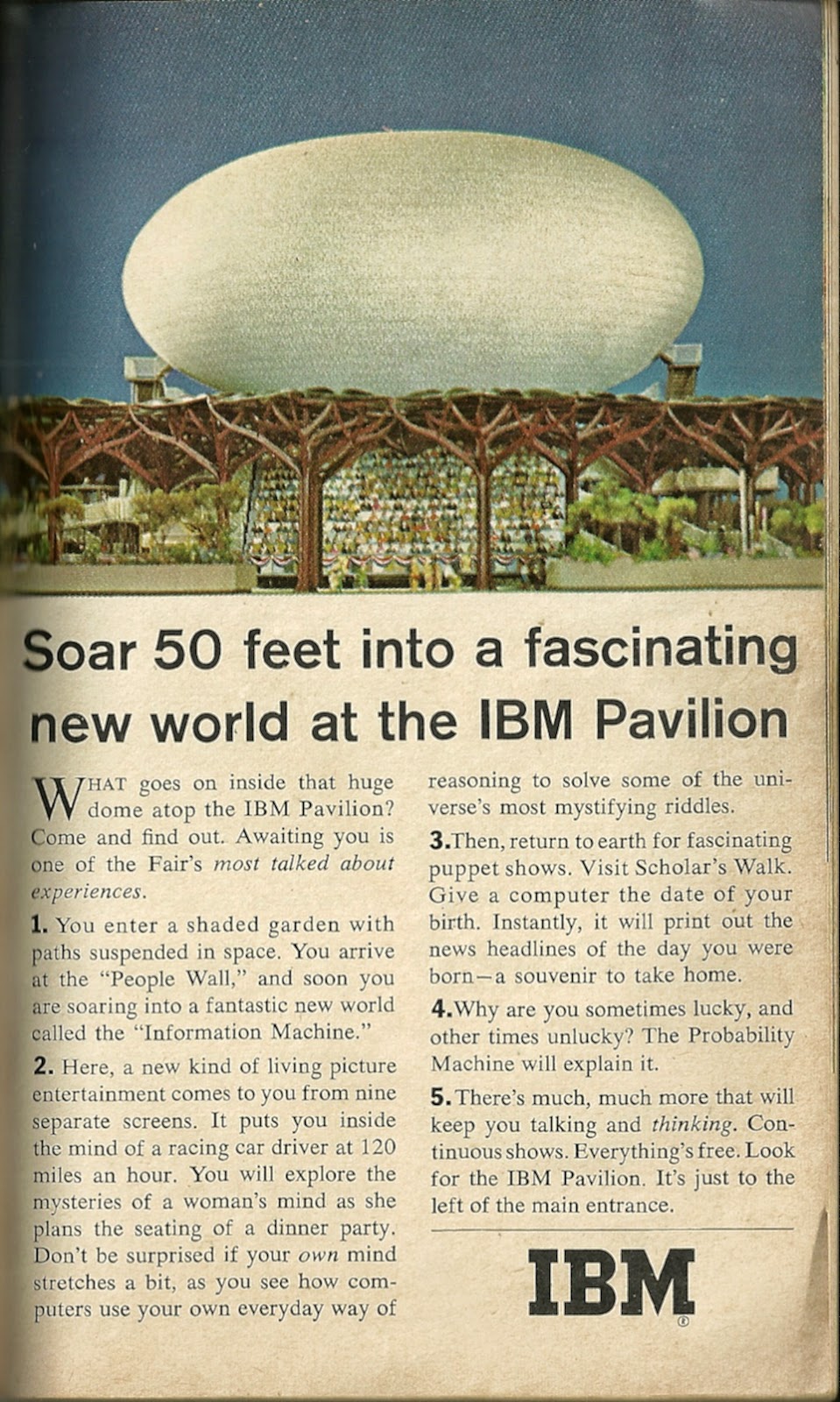
 
I no longer remember anything about the movie, just the experience of it. After the wall of people was lowered, the exit took one past something almost unbelievable. It was a machine that ingested cards. One was invited to write a date on a card, and the machine would not only read the handwriting, it would tell you what happened on that date, as per the headlines of the New York Times. I wrote September 7th, 1950. I was born on the 6th, The Times was a morning paper - if it worked, the headline would tell me what had happened on the day I was born. This was no mere sideshow gimmick, this was the future. The device was called a "computer".


Not quite 20 years and a lifetime later would come a particular Christmas. A few years before, I had rebelled against the standard family gift giving of useful socks and ties, to give things that were fun and hopefully enjoyable. That year, my father and stepmother finally gave in and asked me what I would like that was something fun rather than a necessary item. I told them they couldn't afford what I wanted. After all, it cost over a hundred dollars! Amused, they asked what had so caught my imagination. I told them. It was a Commodore 64c computer. The "c" after the 64 meant that it had a display that was in color. After a couple of weeks they called me back and proposed we split the cost - they would pay half, but there would be no other gift that year. I agreed. I've been at it ever since.
 
There are so many memories of the fair knocking around in my brain, impressions really. But as soon as I see a picture, I can usually tell you what the object was, what  pavilion housed it. After the internet got started, I would perform occasional searches for graphics of the fair. I began collecting the few things that turned up of the 1939 version as well as the 64. There was never much to be found. Over the last few years, a number of pictures and You Tube videos have happily appeared. I've long intended to start posting the ones I've collected, and hopefully I'll now follow through.
 
It was at that fair that I saw visions of the future. It was at that fair that Walt Disney introduced "audio animatronics" (one of Abraham Lincoln stood up and gave a speech!)(and I still have the recording of it), it was at that fair that Ford introduced the Mustang, it was at that fair that I marveled at the exquisite curves and lines of Michelangelo's Pieta and discovered a desire to see art in person rather than in picture books, it was at that fair that I was given a copy of the Book of Mormon, it was at that fair that the world learned the joys of the Belgian waffle, topped with cream and strawberries, it was at that fair that a new type of telephone was on display - you could see the person you were talking to on a tiny screen. Nah, it'd never catch on.  
 
In 1968 I attended college in northern New Jersey, an hour's train ride from New York City. My first excursion was to the Museum of Modern Art to see a silent movie. Train trips are great for reading and pondering. On the trip back from that first day in the city, I finished reading "The Great Gatsby". I closed the cover with a sigh and a great deal of satisfaction. I was only able to afford one year of college. I didn't get the scholarship I needed to continue. I went to Ocean City NJ for the summer, and stayed as I began working to support myself. In the fall of 1972, I moved to Manhattan. It had become the place of my dreams, the center of learning, museums, culture, theatre, music,  movies, bookstores, it was where the world of tomorrow was being born. I would live there on a voyage of discovery for 15 years. Somewhere around 1975 or so, I headed out on the subway to a special stop, a park that had once been an ash heap which had featured prominently in "The Great Gatsby". It was all a bit derelict and sad. Here and there patches of grass peeked through barren soil.  In the center of the park, in an empty fountain, stood a giant globe made out of steel.
 
 
I drifted away, and never went back.
 
Years later I moved on, "a boat against the current, borne back ceaselessly into the past”.


Sunday, February 9, 2014

Hyperbole

When exactly was it? How did it happen, I often wonder, that our language descended into such decadence that the only thing left for it is the phenomenon of 'semantic satiation'? Was it the advertising hucksters who threw adjectives against nouns with punny commercial abandon? Was it the politicians seeking to waltz already malleable truth? Understanding isn't really necessary, even when it is still possible. I suppose this rumination originated with posts on Facebook. Some people post wonderful, funny, fascinating things. Images, videos, articles, news stories, memes. There are many posting groups centered around themes, such as "classic movies", "cute cats and funny furry animals", "my sad tale of woe", "horrid Hollywood homicides", "liberal politics", "Obama is destroying our country", etc. Some of these groups make money for advertisers by delivering a targeted audience. Many times, links are posted to web pages which, of course, contain paid advertising. A 'linked' article may require one to page through, well, several "pages". Pages with advertising. And pop up windows with advertising, and buttons to "like  this" on Facebook, Twitter, or any of a half dozen or more other "social networks". "Liking" basically translates as, "this will cause your friends who use said service to see your name and picture recommending this post, and there is even room for you to make a comment! You will show everyone that you are just so cool and with it by sharing this interest. Or educate them in this topic. Our headline and a few sentences will stay. And, Oh!, we have ads for you, too!") Each page view is rewarded with some one thousandthmillionth something or other of a cent. Volume is money. Advertising brings volume. So, in Social Media Land one doesn't have a "cute cat pic", one has "The Funniest cat pic of all time! I laughed so hard I wet my pants!" A minor and slightly unfortunate happenstance is suddenly an "Utterly Huge Fail!!!". (The latter phrase always seems to be used by individuals who betray no irony in using that particular verb as a noun.) "The Most Incredible Thing Ever of All Time!" It's like an all news channel, constantly producing raised levels of stress.


I'm not an Obama fan, but these "memes" are visual hyperbole and very annoying.
This post was originally going to note that we are midway through the awards shows season, and compare those programs and their breathless reportage with the State of the Union address. Hyperbole being a seemingly necessary ingredient all around. At the moment, however, I've become overwhelmed by "the night that changed the world" and several variations of that phrase. The night referenced is this very evening (February 9th), exactly 50 years ago. In this case, there is no exaggeration.

At 8pm Eastern Standard Time that night, Marconi Mark IV television cameras began broadcasting from what was then known as the CBS 'Studio 50'. It had opened in 1927 as the 1,400 seat Hammerstein's Theater. At various times, it was known as the Manhattan Theater (twice!), Billy Rose's Music Hall, and served as a nightclub. In 1936 it became Radio Theater #3, and then the CBS Radio Playhouse. It was converted into a television studio in 1950. Shortly thereafter, it became the home of "Talk of the Town", which soon changed its name to what everyone was already calling it - the "Ed Sullivan Show". 

Studio 50, at 53rd and Broadway, was a busy place. The Honeymooners was broadcast from there for several years.
As were What's My Line, To Tell the Truth, Password, the Rogers and Hammerstein Cinderella, Kate and Allie, etc.


Sullivan had been a boxer who had segued into being a sports reporter for The New York Evening Graphic. When Walter Winchell left the paper for the Hearst syndicate, Sullivan took over as theatre critic and gossip columnist. He soon had the power to make and break careers using the El Morocco as his home base (Winchell used The Stork Club). As the era of café society began fading, CBS hired him to host a variety show. The show was a huge hit and quickly became required viewing in any home with a tv set. And then there was the night in 1956 when Elvis Presley was on. Close to 83 % of the US tv audience tuned in - over 60 million people. (If someone tells you that they saw that show, ask them about the look on Sullivan's face after seeing Elvis perform. If they describe it, they didn't see the show. Sullivan was sick that night and "Elvin Presley" was introduced by guest host Charles Laughton.) By the way, Elvis was not "cut off at the hips" on that broadcast. That didn't happen until his third appearance.

By 1960, the Sullivan show was so famous that it was used as a plot device in the Broadway musical "Bye Bye Birdie". There was even a song called, "Hymn for a Sunday Evening", which was in the sequence that aired on the Sullivan show (advance the video player to 6 minutes into this clip if you want to just see the number in question performed by Paul Lynde and the cast):


In 1963, Sullivan was traveling through Heathrow airport as the fans of a band returning from a tour went wild. He said it was 'like Elvis all over again'. He offered the band top dollar for a guest spot. The band's manager, Brian Epstein, said he would take far less money - as long as The Beatles got to appear on three consecutive shows, got top billing, and numbers at the beginning and end of each show. Their first appearance was 50 years ago this evening.


Sullivan wisely planned for the bedlam which would follow the Beatles opening segment, and had the second act, a card magician, prerecord his appearance. The third act was the cast of the London musical, "Oliver", which had just transferred to Broadway. While waiting to go on, they had cheered their countrymen from the wings. The teenager playing the Artful Dodger was so impressed by the Beatles' screaming fans that he decided that he would have to become a rock star. After his run in Oliver, he signed with Screen Gems, the tv arm of Columbia Pictures, appeared on a few tv shows, and recorded a record for their label.  He soon became famous as Davey Jones of the Monkees.

The Beatles' Sullivan shows were broadcast in black and white - the show didn't make the change to color until 1965. (1965 was the first year of widespread color broadcasts. In those days, CBS had its own color process, which was different from the other networks. NBC used the system and cameras developed by RCA, which happened to own NBC. ABC was still too poor to afford its own color cameras, so they leased from NBC. In one of those moments of true irony, when color recording was desired for use in the US space program, the RCA designed equipment ended up using the CBS system to accomplish that goal.)

There will be a big Grammy tie in celebration of the Beatles anniversary tonight at 8pm. It will take place in the Ed Sullivan Theater, formerly Studio 50. For the last may years it has been the home of the David Letterman show. I don't know if they will use the old black and white footage - if they do, you'll note that Paul and Ringo often look up - they were looking at the fans in the balcony, which has since been removed. It's a much smaller theater now - these days, they use less than 400 of the seats. When the theater was rehabbed to house hi-definition broadcasts a few years back, a little known passageway to CBS' Studio 52, around the corner on 54th street, was sealed up. That studio, by the by, became better known as the nightclub "Studio 54". The Sullivan show faded away in 1971, victim of an aging demographic and lack of interest in vaudeville style entertainments. And the Beatles? Well, if you don't know that part... just check Facebook tomorrow. There will be lots of posts about them and the show tonight, with headlines like "Greatest Night Ever!", "Colossal Grammy Fail - What Were They Thinking?" and etc.


Friday, May 10, 2013

A Toast for Taylor Mead

It's a sad morning here at the Auto de Fey. I've just learned of the passing of one of the great characters of New York City, the very bohemian Taylor Mead.

If ever there was someone who sashayed to a different drummer, it was Taylor. He was born in Grosse Point, a child of wealthy parents. He referred to his private school education as "brainwashing for the bourgeoisie". Back in the day he lived in a tiny cramped apartment on Ludlow Street and was known in all the worst places. You might stumble upon him reading his poetry at some dive, or you might find him feeding cats in cemeteries. He was often described as the first underground movie star. He was involved in the San Francisco Beat Poet scene, when a filmmaker saw him shouting his poetry over a crowd of drunks in a bar. The filmmaker, Ron Rice, started following Taylor around, filming him with a hand held 16mm camera. The result was "The Flower Thief" (1960), in which Taylor played a befuddled and wide eyed mystic who wandered around San Francisco carrying his three most precious possessions - a teddy bear, a flag, and a stolen gardenia. In other words, he played himself.

He moved to New York City because he thought it would be easy to be anonymous there. But Taylor wasn't the kind of guy who could be anonymous for long (he tended to attract attention) and was soon asked to be in a play by poet Frank O'Hara. He won an Obie. As a regular on the fringes of the Lower East side arty scene, he became involved with Andy Warhol and the gang at the Factory. He played Tarzan in one of Warhol's first movies; as he climbed around in the trees his loincloth kept falling off, leading one critic to complain of the film's featuring two hours of Taylor's derriere. Warhol wrote a letter to the Village Voice noting that no such footage existed, but that he would try to rectify the situation - he made an hour long film called (ahem, my more gentle readers may wish to avert their eyes) "Taylor Mead's Ass".

Dennis Hooper and Taylor Mead in "Tarzan and Jane Regained... Sort Of"
a film by Andy Warhol (1963)
In the late 1970's and early 1980's, in a world before cable tv, the most outrageous program on the air was "The Anton Perich Show" which appeared well after midnights on NYC's own UHF channel 31. Perich was another of the Factory regulars, and his outré avant-garde show featured a number of the Lower East Side crowd like the punk rock country western singer Wayne County (before he was Jane County). The show was vulgar, crude, and absolutely hysterically funny. The funny part was usually Taylor being flamboyantly gay in an era when such things simply weren't done.

For the last several years, Taylor had been in a fight with realtors who were trying to force him out of his long time (and rent controlled) apartment so they could convert it to a high priced market rental. He'd just made a settlement with them and was visiting a niece in Colorado when he passed. He was 88. I want to write "Rest in Peace", but he wouldn't do that. If there is an afterlife, I suspect he'll be busy writing poetry and being very, very, deliciously naughty.


(Bill Rice and Taylor Mead in a scene from Jim Jarmusch's "Coffee and Cigarettes".)

Saturday, May 4, 2013

May the fourth be with you

Life has been far too busy to allow time to post on my blog. I've had several things I've been meaning to get around to, but since I'm retired now... (heh, heh).

Today, May the 4th, is Star Wars Day. It's been celebrated for a few years now. It should really be bad pun day as a tribute to its origins. Needless to say, I was (and still am) a Star Wars fan, as attested by the little round graphic over in the right hand column of my blog page. That is actually a scan of the wearable button that was given out on the very first day of the Star Wars engagement at Loews Astor Plaza Theatre in New York City. They ran out of buttons during the matinees - I managed to get one of the last ones.

I also have the original 1977 Star Wars movie poster, an original Empire Strikes Back "Gone With the Wind" style poster, the Star Wars reissue poster with "coming soon : Revenge of the Jedi" in a banner in the lower right hand corner, the original Variety color insert for "Revenge of the Jedi", etc. (Lucas later decided that "Revenge" wasn't a Jedi concept, so the title was changed.)

It was Wednesday May the 25th, 1977. At the time, I was running the Bookmasters store at 33rd and 7th Avenue, across the street from Penn Station and Madison Square Garden. It was a very large store, and I had hired a friend from my days at Doubleday, Harold Biddle, to run the children's books and remainders departments. That morning, I'd read the review of Star Wars in the New York Times. I decided I had to see it right away as I would hear too much about it otherwise, and never go. Harold and I left work a little early and went off to the 4pm or so late matinee.

Loews Astor Plaza, which opened in 1974, was one of the last of the large screen movie theatres. It was deep underground at the site where the Astor Hotel and Theatre had been. There was an long escalator ride down to the auditorium, which was under the already underground Minskoff Theatre (where I would be fortunate enough to attend performances of "Sweeny Todd, the Demon Barber of Fleet Street a few years later). There were 1,440 some seats, and the screen was said to be as long as a football field. When the movie started, there was a "story so far" kind of scroll as though it were an old Saturday matinee serial. To the best of my memory, the text did not start with "Episode 4: A New Hope". Somewhere I have an (ahem) "private" Betamax video tape of that vintage. When I get my Betamax working again I shall dig it out just to check and see if my memory is correct. The Astor Plaza movie theatre closed some years ago and was converted into a concert venue.

In one of those odd little synchronicities of events, "Pippin", whose advertising
poster can be seen next to the Loews marquee, is currently back on Broadway.
At any rate, the 'story so far' scrolled by, and then a spaceship or two flew around, and then there was this incredible rumbling (the theatre had the sensurround sound system designed for the movie Earthquake - then again, it could have been the rumble of the subway line which was very close by the auditorium). As the rumbling continued a starship began to appear on screen - and it kept going - and going - and going. It was huge! I literally found myself bouncing up and down in my seat. I had ceased to be a 26 year old bookstore manager, and become a kid again. The magic of the movies.

This will probably get me into trouble, but I even like the "special" editions Lucas prepared for the original trilogy's re-release on the original Star Wars (now Episode 4) 20th anniversary in 1997, and which are the official DVD's. Of course, I have the original trilogy on laser disk which are unaltered - and in which Han properly shoots first.

Within a year or two, I'd be out of the book business and in movie distribution. One of the stories I eventually heard was that at the time of the first movie, 20th Century Fox had no confidence in Mr. Lucas' little over budget production. They thought the big hit was going to be a different movie they released that month, "The Other Side of Midnight". In the Boston market, "Star Wars" was relegated to lesser theatres in the suburbs. Allegedly, many distributors were told that if they didn't agree to book Star Wars to follow "Midnight", they wouldn't get either film. This was against the old Columbia consent decree which prohibited 'block booking' - i.e. it was illegal. There were lawsuits over it, there were lawsuits in Boston trying to get Star Wars into the big in town houses. "Midnight" grossed a little over 18 million dollars. "Star Wars" spawned several industries from special effects companies (Industrial Light and Magic), to sound processing, toy tie-ins, and etc. ad infinitum - which have grossed billions.


Over the last few years, as my life hit personal and financial skids, I found myself having to move several times. So, back in 2007, in order not to lose track of my precious first day matinee button, I attached it to a Mickey Mouse Sorcerer's Apprentice doll I had picked up somewhere along the way. As it turns out, that was rather prophetic. I hope the series fares well.

A couple of years ago, when I signed up for Facebook, there was a questionnaire which Facebookers are asked to fill out (one can leave most things blank). One question asked my religious views. I put, "Learn about the Force - and may the Force be with you".


 Oh, one last thing, Thank You for everything Mr. Lucas - but Han shoots first.

Monday, April 1, 2013

The April Fool

Most of my morning has been spent working on this post. Everything looked great, lined up the way I wanted, etc. That was in the Chrome browser that Blogger allegedly prefers. When I looked at it in the Internet Explorer Web Browser, it was a bit of a mess. I've spent two hours fighting to get the text and photos to line up properly. And I just can't seem to win this one. Sorry, I have other things to do and I'm leaving it the way it is.


The morning was appropriately groggy. So was I. The very first email I opened contained news that at the last minute the Vermont Views website, which was listing our community radio station (which I run) as "non-profit of the month" had changed its mind. As I sank into a resigned sigh, the words "April Fool!" entered in my consciousness. There was an audible low guttural growl which emerged from somewhere within my being. It's April. The poet called it "the cruelest month". The poet may have been right.

Over the last two weeks, I've started many a post for the blog, only to abandon them all for various reasons. I had a cataract removed and was laid low for three days by reactions to the surgery. One partial post was forsaken when there were problems at the radio station which resulted in the rest of my day, and most of the next, being spent in email correspondence. I no longer feel in control of my time. I wonder if I ever really was.


Unpacking at the new WVEW studio
Yesterday was Easter. I became a bit lost in reverie. I spent most of last Easter working with the radio station's engineer wiring our new studio It had been almost a year since the fire at the Brooks House which had taken us off the air.
Tuesday, April 10th, 2012 - logging into a computer to
turn on the transmitter and return WVEW to the air. 
We lost everything in the fire - our transmitter was in the studio and our antenna was on the roof. When something like that happens, the station is given one year to get back on the air or lose its broadcast license. Before we left the studio that day, I logged onto one of our new computers and used it to turn on our new transmitter which was now located (with our antenna) at a school on a hill on the outskirts of town. For a few brief minutes, we were on the air. I called Laura over at Austanspace and asked her to tune us in. She heard us. It was real, it worked. While we were working in the studio, the Easter Zombie Walk made its way through downtown. It's an annual local tradition. I hope it was held this year, I haven't been able to find anything on it - I had wanted to go out and photograph it. I made my way out to Austanspace's Shire for Easter dinner. That morning, I'd also put up an Easter blog post which addressed my love for those absurd biblical era movie spectaculars. I'd intended to do another one this year. How on earth did I get all that done? And that list of accomplishment is decidedly meager compared to what I used to accomplish on any given day  during my years in New York City. At any rate, two days later, after calling an early halt to the station's Board meeting, I ushered the Board members into our new studio, logged in once more to the transmitter, and returned our station to broadcast mode. This year, I accomplished - nothing much. And I was busy from the moment I got up until the moment I went to bed.

"Jubilee" Jim Fisk
Today is the birthday of James (Jubilee Jim) Fisk. He was one of the Robber Barons of the Gilded Age. Born on the other side of the state, his family moved to Brattleboro when he was a child. His father became the owner and manager of a hotel on the corner of Main and Elliot Streets, known as the Revere House, in the days when Brattleboro was a resort town famous for its "water cure". At the age of 15, he ran away and joined the circus. There are reports that he made a fair amount of money by smuggling cotton during the US Civil War. He became a stockbroker working in the office of Daniel Drew, another famous thief of the financial world. (Drew's money founded a Methodist Seminary which expanded to become Drew University, which I attended in 1968-1969.) Daniel Drew was the kind of guy who used to have his cattle drink water to increase their weight just before their price per pound sale. His shady deals became known for using phony and unauthorized stocks, thereby lowering their value. Such stock were soon called "watered down" in his dubious honor.

At the offices of Daniel Drew, Jim Fiske hooked up with Jay Gould. Together they assisted Drew in manipulating the price of Erie Railroad stock, which they swindled away from Cornelius Vanderbilt. They eventually swindled the Erie away from Drew for good measure. They were openly allied with New York City's notoriously corrupt mayor "Boss" Tweed in the bribing of judges and legislatures. They also caused a financial panic which ruined many investors when they convinced President Grant to purchase and hold on to gold; they had the United States Assistant Treasurer in on the deal while they manipulated the price. For their offices, Gould and Fiske bought the Pike Opera House building at 23rd Street and 8th Avenue in NYC.

Samuel Pike had purchased much of the old Clement Clark Moore estate and built upon it a five story opulent 1,800 seat opera house which cost over a million dollars, unheard of at the time. Although the area quickly became a theater district, Pike was never able to lure patrons away from the Academy of Music on 14th Street. Within a year of its opening, Pike closed it. Fisk and Gould bought it and spent another million renovating the building, renamed it the "Grand Opera House", and became theatrical impresarios as well as financiers.

Pike's Opera House


Josie Mansfield
Now, Fisk had married young, and lived apart from his wife. She stayed in Boston with a close female companion. He also purchased a building close to the Opera House and had a secret tunnel built to connect the two. The apartment was for his mistress, Josie Mansfield, an actress.

Edward Stokes


  Mansfield's affections were soon shared with one of  Fisk's employees, Edward Stokes.  Stokes left his wife and children and moved in with her. Together, they attempted to bribe Fisk through the use of letters which detailed some of his underhanded dealings.  Fisk refused to pay up, and started a public relations battle. Stokes was arrested on charges of embezzlement. (It's a long story.) One year to the day of his arrest later, nearly bankrupt and ruined, Stokes shot and killed Jubilee Jim Fisk on the staircase of the Grand Central Hotel. Fisk was 36 years old.

Fisk's body was brought back to Brattleboro for burial in the Prospect Hill cemetery where a large monument was erected to his memory. The monument's central stone is surrounded by four scandalously underdressed (i.e. bare breasted) women, each of whom holds something connected to Mr. Fisk. One holds pieces of railroad track. One, a money bag. Another holds a steamship (another Fisk story). The last holds an emblem of the Opera House.

Fisk's story became the subject of a 1937 movie, "The Toast of New York", bears a great resemblance to part of the plot for the movie "Citizen Kane", and was the subject of several best selling books. Edward Stokes served four years of his prison term before being paroled. Fisk had given freely to charity and was in held in esteem by many - upon his release, there were numerous threats made against Stokes who spent the rest of his life looking over his shoulder and feeling hunted. Fisk's wife died in poverty in Boston. Josie Mansfield made her way to Paris where she married before returning to the states. The rest of her story is unknown. She was rumored to have lived under assumed names in Boston, and in New Jersey where she allegedly died, as per a report in the New York Times. There is one published report that she found her way back to Paris where she died at the American Hospital. There are also newspaper reports that, paralyzed and in dire poverty, she entered a convent in South Dakota to avoid the poorhouse, passed and was buried in an unmarked grave.

The Grand Opera House puttered on for many years, never very successfully. It was purchased and turned into a movie theatre, the RKO Grand in 1938. It continued operating until 1960 when it was  closed, slated for demolition when the Ladies' Garment Union began  redevelopment of the area into the Penn South residential apartments for union members and their families. Two weeks later, it burned to the ground. It was eventually replaced with a nondescript three story office building, the memories of Robber Barons, the Grand Opera House, Jubilee Jim, his mistress, and the Gilded Age long gone.

A current view of the corner of 23rd Street and 8th Aveue, New York City


Sunday, January 29, 2012

The flood this time - continued

All in all, I spent over 6 hours yesterday dealing with cleanup from the mini flood in the building's basement. The box of DVDs that was sitting on the floor absorbed enough moisture that the box itself had to be thrown out. But the contents were, by and large, dry. The DVD box for The Chronicles of Narnia pt1 suffered some damage. I'm not sure how that disc even got into my collection - it must have snuck in with some of the review copy DVDs I got when I was running the video store. I've never seen the movie(s). And I guess I should confess that I've never read the books. It's just as well, if I had them, they'd probably have been lost in the flood, too.

Which is my way of noting that I have had several storage places over the years. All of the Vermont ones (with the singular exception of a friend's barn which amusingly enough has holes in the roof) have had water damage to my stuff -damage to the privately printed complete Richard Burton translation of the Arabian Nights was the real heartbreaker. I had my copy since my days running a very big bookstore in New York City, the Bookmasters store across 33rd Street from Madison Square Garden, and across 7th Avenue from the Statler-Hilton Hotel.

The last time I saw that set of books for sale was in Boston in the late 1980s or early 1990s. (I'd get lost in time if I tied to come up with the right year...) and it went for $1,000.00 I think my copy is currently in storage in my friend's barn. I don't remember what all I sold when I first went flat out broke a few years ago. Sigh. Sold all the Edward Gorey books, a lot of the Roman and Greek classics I never got around to reading, the resource materials I had for all that "in a timeline as written" reading that I never got around to (ancient maps, books of architecture and costume, etc.) Ah, well. Semi-retirement's coming.

Oh. That Bookmasters store.

Yes, that's me somewhere around November 1977.
The books and promo materials were delivered in an ambulance.
I have a picture of it around here somewhere. I'll look.


Madison Square Garden was built on the former site of the Pennsylvania Station, NYC's great transit terminal. By my day, the station had been torn down, moved underground and had the Garden built over it. The loss of the old building used to be regarded as one of the great architectural tragedys of the modern world. I never got to see it. I do remember the old Whatchi ma hootziz over on Lexington there, you know , ah ---- Grand Central Station. So, I can sort of suss out from the photos how Penn Station looked and must have felt. Sorta.

These pics from the wonderful Shorpy site give a good idea of the sheer size of the place...


These give a good idea of the atmospherics:


So, that's what used to be across the street from the store. Across the street on he 7th Avenue side was, as I mentioned, the Stater-Hilton Hotel. Which had previously been The Pennsylvania Hotel. Which just celebrated its 93rd Birthday 4 days ago. Inside the Main Entrance, to the left of the lobby, walled off and unused, is a huge old dining room/supper club. The room has two raised wings for a total space of 58 feet by 142 feet. The ceiling is 22 feet high. It used to be the Cafe Rouge. Although its had several uses over the years, including an ignominious turn as a souvenir shop (with the old dance floor showing underneath the worn linoleum), I've read that it's all still there, the fountain and everything.


It was the premier night club in New York City in the late 1930's and early 1940's. Artie Shaw played there. During his engagement in November of 1939, he quit the business there. Benny Goodman played there. Duke Ellington played there. Basie played there. Most of the big bands did. And for about three years at the beginning of the 1940's, it was home base for Glenn Miller and his Orchestra. Miller hired a couple of the unemployed Shaw musicians, including Shaw's main arranger, Jerry Gray. While with Miller, Gray came up with "Pennsylvania 6, 5000", which became a huge Miller hit. It's the hotel's telephone number, said to be the oldest number in continuous use.


There were broadcasts from the Cafe several nights a week, and on weekends there were even broadcasts in the late afternoons - it was also the site of many of Miller's "Sunset Serenades" USO shows. There were also broadcasts from the hotel's cellar club., around the corner and slightly down the side street, the Madhattan Room. For a couple of seasons it was the home base of Benny Goodman from the days when Harry James and Ziggy Elman were in the trumpet section, and  Gene Krupa was the drummer, when Swing was was becoming king.

Over the years, the Hotel fell on hard times, and its once great reputation nearly destroyed. The current owner bought it in 1997 with the intention of demolishing it for a new high rise. A group formed to save it, but their attempts to get landmark status for the building and for the Cafe failed. Last December the owners suddenly changed their minds and say they now intend to renovate it. 


       Fin.

Tuesday, January 24, 2012

Bingham Ray

This morning I became unstuck in time again.

Work today doesn't start until 3:15pm, so I was enjoying a leisurely click through fest of the news , my recent eye problems making it difficult at times to read, when I clicked my way right into the news that Bingham Ray had died.

Bingham was just a few years younger than I am. He was out in Utah where he had just attended a conference and was about to attend the Sundance Film Festival. I called my old friend and something of a mentor in the film business, George Mansour right away. Bingham had had a little stroke and Richie Abramowitz drove him to the hospital. Everything was fine. Until the next day.

These are names from my past, years ago in film distribution in New York City. Bingham managed the Bleecker Street Cinema (after John Pierson, I think...). He became a booker for Walter Reade for awhile, and if I remember correctly, it was Bingham who was responsible for saving a little art deco cinema called the Metro, which was way uptown on Manhattan's West Side (99th Street). It had originally been the Midtown, and was one of those little jewels of the movie theatre biz.


At the time, revival and repertory were all the rage. People had discovered the joys of seeing old movies on big screens again after years of late night showings on television. I've often mentioned that my opinion of John Ford as a director changed completely after seeing his movies on a big screen as opposed to tv.  The movies of that era were thought out in terms of 20+ foot high screens. It would take too long to explain what I mean, so here's a quick, not very good example, a scene from the 1939 "Stagecoach", in the wrong frame ratio to boot.


Kind of impressive looking, eh? Ford liked to film in Monument Valley. Well, click on the image and blow it up until it fills your screen. It's not the same image anymore, is it? Ignore the soft focus, I didn't have time to find a good hi res still. Even the point at which your eyes naturally focus shifts.  Big screen. The Metro had a decent sized screen. It was a joy to see old movies there. They felt at home. It wasn't as big as a screen as at the Regency, the leading revival & repertory house, but I liked the theater a bit better. Bingham and I used to trade potential double bill titles. He was kind enough to run several of them. One (at least, in memory it was my suggestion - after all these years, I wouldn't swear it wasn't his) was my favorite, a pairing of two film noirs, The Big Sleep and In a Lonely Place - now forever known as "Gloria in excelsis" for Gloria Grahame who appeared in each. (I also once ran a theatre bookstore that used to sell her her scripts and sound effects for year yearly summer tour in The Glass Menagerie. We had just gotten one year's materials in when she died.)

Ms. Grahame and Bogart "In a Lonely Place" a story of a washed up Hollywood screenwriter and his neighbor.


His management of the theater was so successful, in an out of the way neighborhood, that it was twinned and turned in to a first run house. It seems to me that he booked the Film Forum for a little while before he moved on into film distribution, but my memory of those years is getting a little fuzzy and takes a while to sort some things out. The Metro was bought and sold, and closed shortly after the nearby Olympia kept a date with a wrecker's ball. It was slated to become a supermarket, but that deal fell through after the exterior was awarded landmark preservation status. Then it was going to be a trendy clothing shop. Then an apartment house. Last I heard, it was still there, sitting idle, most of the interior gone.I believe it is now slated to become a performing arts school. I hope it has survived.


Details from the interior like the following, however, are long gone:


Bingham made quite a name for himself in the world of independent movies, and was co-founder of October Films (still around after being bought and sold several times, now under the name Focus Features). Bingham is one of the people who built the market for, and took the chances on financing, serious art films in this country. For a couple of years, he even headed United Artists, when it was a specialty division of MGM. Some of the movies he championed include Bowling for Columbine. Life is Sweet. Secrets and Lies. Breaking the Waves. The Last Seduction. There are many, many more.

And I'd go on and on if I could, remembering when there were so many theatres where one could go and see art films and old movies and third and fourth runs, the St. Marks (what a pit! One never wanted to put one's feet on the floor in that place), Theatre 80 St. Marks where Howard Otway used to show 16mm movies in rear projection, The Cinema Village, the Paris, the Walter Reade, the 57th Street something or other where the Chaplin movies played, I'd go on, but I must leave for work.

Take care, Bingham Ray.
As my friend Austanspace would say, Ya did good.