Showing posts with label fading images. Show all posts

Thursday, March 2, 2017

Dreams remembered

For the last few days those moments just before waking have provided a continuation of the same dream. I don't remember most of it; Dreams often fade quickly. I can recall that just before waking, in an era in which people with education were suspect, a roundup of intellectuals and dissidents had begun.
I was trying to save people, including myself.

Every morning has seen an intention to write in this space. I have started many posts, and left them abandoned. I am certain of the cause; it starts, much as it always does, with reading the news. It just happened again as I began sipping my coffee on a beautiful late Spring morning during the last official month of winter. The news makes me wonder about the use of winter as a metaphor.

For many years, I have kept a file in the "pictures" section of my computer labelled "Dreams Remembered". It consists entirely of old, often fading, photographs of men together, or women together. They are part of a history intentionally buried. When such images were found, often I would guess after the owner of the photo passed, they were destroyed by concerned family members. A good number of them escaped attention even though the pictures seemed to show affection between the subjects. After all, people note, men and women were freer to show affection to each other in days gone by. Such photos depict good friends, or family members. Yet now, in a more liberal time, many such photos seem to imply other relationships were depicted. They may be mementoes of a more innocent time, but they are also stories lost, or destroyed. For those who can see what is there, they are dreams remembered.

Two civil war soldiers in a hand tinted photo from the Library of Congress, posted to the Shorpy site.
Lest anyone assume that over interpretation is involved, here's a relatively sedate photo in which closeness
is portrayed, but there is no physical contact. Poet Walt Whitman is on the left, Pete Doyle on the right.
Pete Doyle, it should be noted, was Whitman's lover.
Having one's picture taken in those days was expensive. There was only one copy per photograph.
Were these two friends sharing an expense, a memento of a friendship, or something more?

As the process of photography changed and the cost was reduced,
some photographs began to suggest a little more about the nature of a relationship. 

These dreams come to mind due to a four night drama program which has been unfolding on the Disney owned ABC broadcast television network. "When We Rise" is a slightly fictionalized story of three people whose lives intersected in San Francisco, and the parts they played in the gay liberation movement.  The first part was shown on Monday, just a few days after the newly installed U.S. Attorney General rescinded and abandoned the previous administration's policy that allowed transgender teens to use the bathroom of the sex with which they identify. The new Attorney General had promised, just a few days before, that despite his past record in the segregated South, he would uphold civil rights of all Americans. He was passed on a party line vote, "conservative" and reactionary Republicans outnumbering the Democrats. The mini-series episode that night portrayed a time, in the first years after the Stonewall riots, when gay men and women were considered mentally ill, were routinely denied the rights of Americans, were routinely dismissed from their jobs, thrown out of their homes, denied housing, and just as routinely beat up and/or killed by thugs and police alike. I remember all of it, and was not ready for the pain it brought back.


Anita Bryant, pictured above, was a singer and orange juice pitchwoman who campaigned to rescind a Florida law
which banned discrimination of the basis of sexual orientation. She famously said that she would prefer
"my child be dead than homo".


The second night of the mini-series was postponed due to the new President of the United States giving an address to the entire assembled Congress. The speech was remarkable for dropping Mr. Trump's confrontational style, acting like an adult instead of a raving lunatic. The immediate response from the press, which Mr. Trump had constantly belittled, castigated, accused of making up stories (i.e. the unfavorable ones), and declared the enemy of the American People, was overly kind, remarking that he suddenly seemed presidential. They didn't really discuss his misrepresentations, distortions, outright lies, and attempts to cover up what may or may not be the truth.


Last night's episode of 'When We Rise' focused on relationships being built by the story's participants, the elation of the election of a gay man (Harvey Milk) to the San Francisco Board of Supervisors, his assassination 11 months later, and the rise of what was being called a 'gay disease'.


The episode ended with one of the principals holding a protest in which people in San Francisco began posting the names of friends and lovers lost to this new disease onto the side of city hall. I've been crying a lot. The memories of the death of dear friends, the men with whom I was forming my family, have been overpowering.


This morning, intent on resuming my post of thoughts arising from the old movies I've been watching, I logged onto my computer to discover news that the new Attorney General had been caught lying about his contacts with Russia. These contacts, as well as a number of others surrounding the new administration, seem to expand into an ever deepening well. There are lies upon lies. As the stories of investigations into these incidents become public, they aren't just denied, the press is accused of making them up to discredit the President. Also in the news were further stories about the new administrator of the Federal Communications Commission and his repeal of polices protecting access to the internet, programs which helped the poor afford the internet in their homes, and rules of privacy which had hemmed in internet providers ability to keep records of what sites and information anyone had accessed. All of this is, of course, in the name of fostering business growth and competition. Such information would never be used to assist in rounding up people.


Other news stories concern the President's travel bans, people being deported due to such criminal backgrounds as having traffic violations, people being detained for hours or days without warrants, people having their identification papers checked as they left a flight which started and ended within the United States, and so forth. When the travel ban was imposed to protests and legal actions across the country, Homeland Security backed the President. They will be getting 15,000 new agents. The Department of Defense will get billions, partially to fund new atomic weapons. Other areas of the budget will have to be cut; these include monies for health care, social security, education, and the arts.


The man in the center of the above photograph is Bix Biderbecke. He is one of the men who was instrumental in the development of jazz. He was an alcoholic who died young, at the age of 28. He was gay.


Sunday, April 27, 2014

The green light at the end of the dock...

Last week one of those anniversaries that media outlets love to note occurred. Network tv stations, as well as various internet outlets, showed about 30 seconds worth of fuzzy film footage before moving on to something else. But that little bit of 'soft news' gave me pause. The warm glow of nostalgia, as fuzzy as the images, began to flow. Yes, I had been there. I had seen. I had experienced. I had lived.

You see, on April the 23rd, it was 50 years to the day since the New York World's Fair of 1964 - 1965 opened. A couple of times, it was referred to as "The World of Tomorrow". That phrase was, we were told, the slogan of the fair and was solemnly intoned while a picture of the Unisphere was shown. Except it wasn't. That  was the slogan of the 1939 - 1940 fair, held at the same location. In fact, the symbols of that earlier fair, the Trylon and Perisphere, were in the same exact spot where the Unisphere was built. The Unisphere was the largest model of our planet ever constructed, made out of the finest U.S. Steel. It was at the center point of the fair in a reflecting pool, surrounded by fountain jets of water which reached upward to the sky mirroring our hopes and ambitions for "Peace Through Understanding",  the fair's actual motto.

I knew all of this for the simple reason that I was 13 years old and desperate to escape (even for a few paltry hours) from my ordinary little home town in the southern part of New Jersey. This wasn't just a World's Fair, it was a New York World's Fair. Baghdad on the subway. Visions of delightful (but unspecified) decadence floated before my mental eyes like those conjured by the Devil to tempt the Christ during His sojourn in the desert. I knew this for a fact; I had seen the movie.

I managed to get to the fair twice. If memory isn't playing a trick or two to embroider the sense of stultification I was experiencing in my hometown, there was an excursion with the Methodist Youth Fellowship, and a trip with the Boy Scouts. I was that desperate to go. It is a wonder I remember that part at all. I remember the long bus journey there. I remember walking down a seemingly endless boardwalk, through an awning of stylized wings that seemed poised to take off . Without warning, rising from a sea of color, it loomed in front of me, a vision, a dream, a temptation - the Unisphere. I had arrived.


There had been months spent in expectant, torturous, exquisite waiting. My father allowed that he hated New York and would get nowhere near the place, but that as a teenager he had gone to the 1939 fair and loved it. I had already found the jig saw puzzle he had purchased as a souvenir. It was a map of the fair, and was missing pieces. I had still put it together, and fallen in love with the Trylon and Perisphere symbols. After a bit of outright begging, he allowed me to use his 8mm Bell and Howell camera to take movies while I was there. The camera was a little finicky as to settings in strong daylight, so he also allowed me to use his light meter. Weeks later I would discover that the light meter was no longer working properly and the footage of the fair was horribly overexposed. For the 1965 edition, he allowed the use of his new super 8 movie camera, after the requisite repeated begging of course. One of these days I must get those put into digital format. I didn't take still pictures, but I did take slides  - with my new Instamatic camera, purchased at Mr. Duper's Hobby Shop on my town's Main Street. The Hobby Shop was next to the storefront that was the Greek's diner where I used to purchase my cherry cokes after the soda fountain at the Rexall was removed. If the place had a real name, I never knew it. Everyone called it "the Greek's", a bow to the ethnicity of its proprietor. It was on such an excursion that I'd noticed the arrival of the new Kodak camera on display in the Hobby Shop window, and began to save my pennies.


When the Kodak pavilion was included in the 50th anniversary news reports, only one mentioned that it displayed the largest color photos made up to that date. No one mentioned that the rest of the building's roof was a futuristic moonscape - with spots which had placards which noted them as being perfect for taking pictures of the fair. Which brings up one other little matter, best illustrated with this commercial:


The reason I wanted to post that is very simple - it is in black and white. So was television then. In fact, it was at the fair's RCA pavilion that color tv was first demonstrated for eager dreamy eyed buyers. (Movies had been black and white, too, with color saved for big budget spectaculars and musicals.) Quite a bit of what has turned up documenting the fair is in black and white, which does it a great disservice. It was the early 60's, the world had become color, and the circus had come to town.

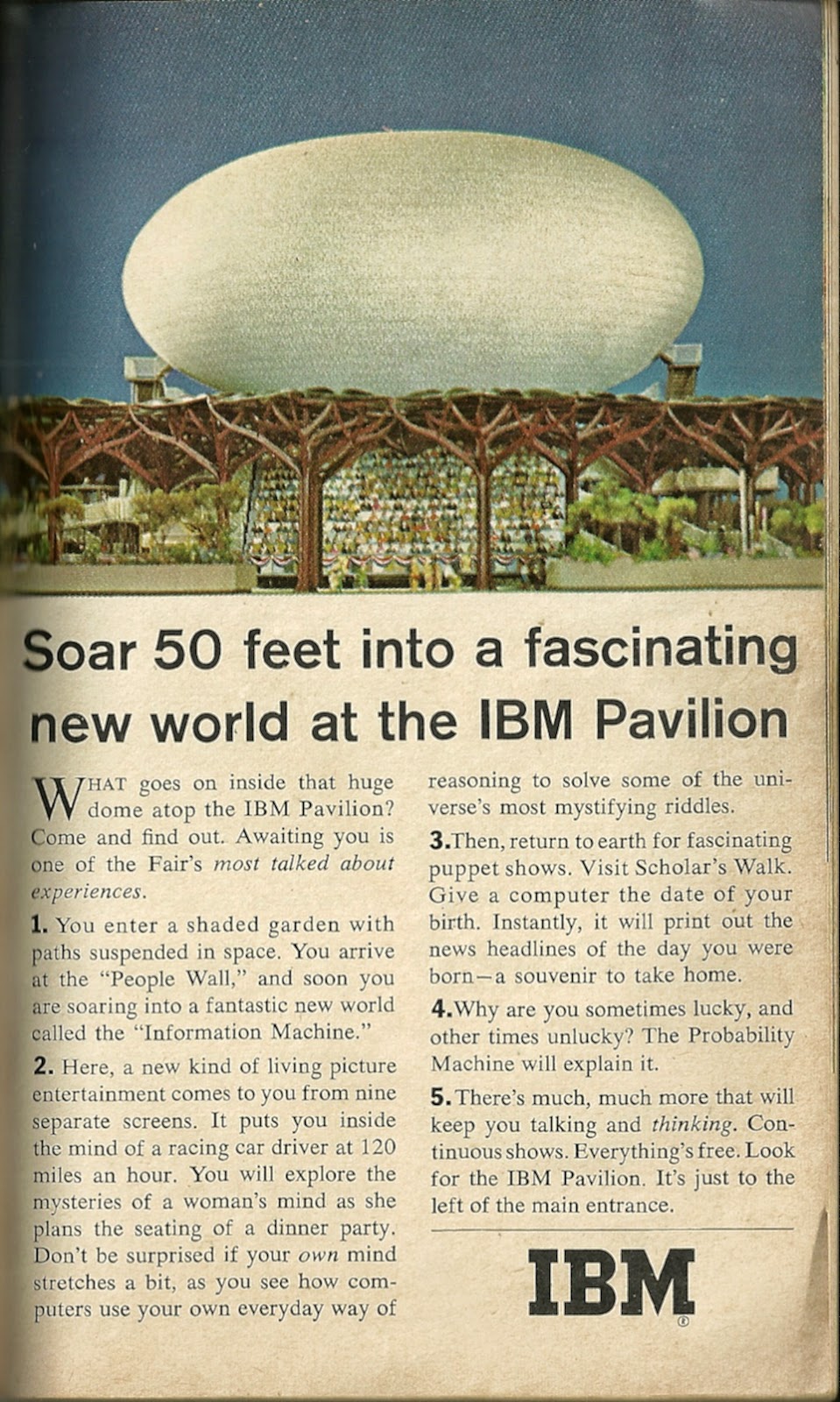
One of the exhibits which fascinated me the most was the IBM pavilion. Floating above what seemed like a sea of metal treetops was a giant egg. I've never been sure what that was supposed to represent, or what meaning was attached to it. Perhaps it was an expression of the Dadaist sensibility inherent in the newly emerging corporate environment. Here's the advertisement for it from my 1964 guidebook to the fair. Notice the color wall in the center - it was row upon row of seats, steeply raked. The wait to sit there seemed like it would take you clear into 1965. After every seat was taken, the wall was raised via hydraulic lifts into the egg where a movie was exhibited on a series of giant screens. It was wonderful.

 
I no longer remember anything about the movie, just the experience of it. After the wall of people was lowered, the exit took one past something almost unbelievable. It was a machine that ingested cards. One was invited to write a date on a card, and the machine would not only read the handwriting, it would tell you what happened on that date, as per the headlines of the New York Times. I wrote September 7th, 1950. I was born on the 6th, The Times was a morning paper - if it worked, the headline would tell me what had happened on the day I was born. This was no mere sideshow gimmick, this was the future. The device was called a "computer".


Not quite 20 years and a lifetime later would come a particular Christmas. A few years before, I had rebelled against the standard family gift giving of useful socks and ties, to give things that were fun and hopefully enjoyable. That year, my father and stepmother finally gave in and asked me what I would like that was something fun rather than a necessary item. I told them they couldn't afford what I wanted. After all, it cost over a hundred dollars! Amused, they asked what had so caught my imagination. I told them. It was a Commodore 64c computer. The "c" after the 64 meant that it had a display that was in color. After a couple of weeks they called me back and proposed we split the cost - they would pay half, but there would be no other gift that year. I agreed. I've been at it ever since.
 
There are so many memories of the fair knocking around in my brain, impressions really. But as soon as I see a picture, I can usually tell you what the object was, what  pavilion housed it. After the internet got started, I would perform occasional searches for graphics of the fair. I began collecting the few things that turned up of the 1939 version as well as the 64. There was never much to be found. Over the last few years, a number of pictures and You Tube videos have happily appeared. I've long intended to start posting the ones I've collected, and hopefully I'll now follow through.
 
It was at that fair that I saw visions of the future. It was at that fair that Walt Disney introduced "audio animatronics" (one of Abraham Lincoln stood up and gave a speech!)(and I still have the recording of it), it was at that fair that Ford introduced the Mustang, it was at that fair that I marveled at the exquisite curves and lines of Michelangelo's Pieta and discovered a desire to see art in person rather than in picture books, it was at that fair that I was given a copy of the Book of Mormon, it was at that fair that the world learned the joys of the Belgian waffle, topped with cream and strawberries, it was at that fair that a new type of telephone was on display - you could see the person you were talking to on a tiny screen. Nah, it'd never catch on.  
 
In 1968 I attended college in northern New Jersey, an hour's train ride from New York City. My first excursion was to the Museum of Modern Art to see a silent movie. Train trips are great for reading and pondering. On the trip back from that first day in the city, I finished reading "The Great Gatsby". I closed the cover with a sigh and a great deal of satisfaction. I was only able to afford one year of college. I didn't get the scholarship I needed to continue. I went to Ocean City NJ for the summer, and stayed as I began working to support myself. In the fall of 1972, I moved to Manhattan. It had become the place of my dreams, the center of learning, museums, culture, theatre, music,  movies, bookstores, it was where the world of tomorrow was being born. I would live there on a voyage of discovery for 15 years. Somewhere around 1975 or so, I headed out on the subway to a special stop, a park that had once been an ash heap which had featured prominently in "The Great Gatsby". It was all a bit derelict and sad. Here and there patches of grass peeked through barren soil.  In the center of the park, in an empty fountain, stood a giant globe made out of steel.
 
 
I drifted away, and never went back.
 
Years later I moved on, "a boat against the current, borne back ceaselessly into the past”.


Thursday, February 27, 2014

It worked! (So far)

Since yesterday morning, I haven't had a single spam message here on the blog. I didn't want to put any restrictions on anyone's ability to post a response to my ramblings, thinking such restrictions to be a tad unfair, forcing one to be a member of the club so to speak. In a better world.... but I might as well believe in the realm of Prester John where growth hormone free milk and honey from flowers whose plants have never seen a pesticide or genetic modification flow with equanimity to all.

Without looking back through the comments, I do believe that both Delores and Geo recommended this move. I should have taken their advice years ago. What can I say; aging, stubborn male at work.

There have been so many odd little things capturing my attention lately. Many of them have been of archeological origin. The mounds of Ireland became a huge fascination last month. I'd often wondered about them, having first become aware of the concept as a teenager reading Tolkien. In January, my online perambulations let to a website about the 'passage' mound at Newgrange. It's older than Stonehenge. Older than the pyramids at Giza. At the entrance to the mound, and at various points inside, spiral carvings are present. Their meaning is unknown. To me, they look like a map of the area's mounds, waiting for a present day Schliemann to follow their clues to some ancient secret.

Spirals at the entrance to the Newgrange mound, photographed around 1905.

The inner chamber at Newgrange is filled with sunlight on the winter solstice. There is a lottery every year to see this effect. I'd love to go, adding it to my list of places to be experienced should I ever acquire funds to travel. Stonehenge is on the list, as are the pyramids and so on and so forth. Over the last couple of years, I've realized that I have long been fascinated by monumental architecture. Giant tombs of antiquity and ancient ruins don't limit this interest. For instance, I would love to see the Colosso dell'Appennino, a sculpture by Giambologna erected in 1580. It was part of a large estate in Tuscany which was abandoned and mostly demolished in 1820. The estate changed hands a few times, became an English style garden, etc. It is currently owned by the province of Florence and is open for visitors from May to September.


The Colosso dell'Appennino

What is it about such structures that fascinates me? The idea of sailing on a body of water and suddenly stumbling upon something like this immediately comes to mind. Perhaps it is one of the few areas of life left in which one might find a little bit of mystery or romance. Imagine trekking through a jungle and chancing upon the remnants of an earlier civilization, overgrown and forgotten: 


It's not that I have a secret wish to be a latter day Indiana Jones. Perhaps it's a desire for wonder, a curiosity about whomever left something like this behind, how and why it came to be built. Perhaps I just have a need to see things like this for myself because I no longer trust the internet - there are too many people with Photoshop skills and time on their hands to create images that fascinate. I have no idea if the following Easter Island picture is real, but I have found variations of it with other people in the picture, so I suspect that it is.
 
 
Sometimes it is the part we can't see that holds the real fascination. In early photographs of the Sphinx, the arms are not visible. They had to dig out around it to expose them. I wonder if they've dug out around the pyramids?

A couple of years ago, I started a specifically uncategorized file of pictures which I find interesting. It's main purpose is to provide a slideshow screensaver which kicks in after the computer is idle for 5 or 10 minutes. There are many pictures similar to the above in the folder. Others are of movie theatres, or the long vanished Pennsylvania Station, advertising from years gone by, my own attempts at photography, movie posters, classic automobiles, all the sundry items which have caught my interest. I have often found myself sitting here staring at the images, lost in wandering thoughts, unable to interrupt the show to return to whatever project it was on which I was working. Quite often, reality would intrude with the jarring sound that plays when I get email. I used to have a nice, quiet sound that I liked selected for this purpose, but a problem with Norton led me to let a woman in India resolve it by giving her control of my computer for 20 minutes. I watched and was able to stop what she was doing if I felt it was needed. Somehow, the process changed a few settings and I've never been able to get things completely back to the way I had them. Perhaps change is good, I reasoned, and gave up the fight. (For awhile, anyway. ) In the meantime, the sound which wakes me from such reveries is not tolling for me at present, the blog is not reporting a stream of spam. But I have too much to do to let myself wander around monuments, or wonder why they fascinate me so. (sigh)


Monday, January 27, 2014

Return of the prodigal

It was barely noticed. It happened about a week ago now. One of the survivors of an alleged golden age, Paramount Pictures (bought and sold a few times since its founding), quietly announced that they were no longer releasing their product on film. The age of celluloid is ending; it is now an analog to digital, but the age of 'analog' is dead too. It gets confusing.


Two weeks ago, I was quite touched to receive notification that Delores had posted here, noting that I was, more or less, missing in action, and hoping that I was okay. An immediate reply was called for, I headed towards a response... and got sidetracked. Every day. For two weeks.

Its' not like I haven't been busy. I haven't really, but I do always seem to be occupied with something or other, even though I can't always say what that something or other is or was. I do remember some of what I was doing around the time Delores wrote.

I rarely go to the movies anymore. It's not that I don't want to. They are just so damned expensive now. One of the movie theatres here in Brattleboro closed a little while back. To tell the truth, it wasn't much of a move theatre.
From Jerry Lewis Twin, to First Cinema, to the Kipling... 
a former manager (my friend Brayton who tried to save it)
stands in front of the closed theatre, since torn down
 to make way for a discount supermarket.
It started life as a Jerry Lewis twin. At one point it was owned by a vice-president at Warners, and the subject of lawsuits. It was a bit of fun as long as your entertainment didn't need to be the movie. It was from the days not so long ago when screens were put at the end of hallways, some seats thrown in, sound of dubious quality added, and Lo! the suckers were separated from their cash. Our other theatre, the Latchis, is one of the survivors of an age when there was a bit more showmanship involved in everything from the auditorium's architecture to the presentation of vaudeville entertainments with a movie. Since the Kipling closed, it has moved from a concentration of what used to be thought of as art house product to standard commercial releases. Not the standard commercial releases of its heyday. The Saturday afternoon serials and B pictures of those days are now the A product, the major releases. Most have little more substance than comic books. Glorious comic books, to be sure. The special effects are great. But most of the product is empty headed nonsense. Not that there is anything wrong with that. But as much as I like corn, I can't eat a steady diet of it. And I can't say that I'm all that enthused about seeing movies like "12 Years a Slave", which from what I heard borders on what has been termed "torture porn".
The Latchis main auditorium, its ceiling restored, with the first new seats since it opened in 1938.

The thing of it is, two weeks ago I went to the movies - twice. The first was at our local library to see Hitchcock's "Strangers on a Train", the start of an every other week film noir series. The host tapped to discuss the movies shown is a screenwriter who moved into the area a little while back. His main claim to fame is a co-author credit for the script of "Revenge of the Nerds".

Farley Granger and Robert Walker in "Strangers On A Train"
(If merry-go-rounds make you nervous, do not see this movie.)
A few days later, there was a special show at the Latchis of "Lawrence of Arabia" as a memorial to the late Peter O'Toole. I had mixed feelings about seeing it again. It's a wonderful movie, one I refuse to watch on tv. (So here's the trailer on an even smaller screen.) It really needs a big screen. A friend wanted to go and asked me to accompany him, otherwise I might have passed on it. I saw it when it was first released. I used to have a 16mm print which had been subtitled for the deaf. I always found it odd that it had the best sound of any 16mm print I ever owned.


I worked for Columbia (its releasing studio) when the 1989 restoration was done. That work started under studio honcho and filmmaker David Puttnam. His philosophy was to make only one or two big budget titles a year, with lots of little movies, all of which stood excellent chances at turning a profit. Of course they fired him - he had, after all, refused to make Ghostbusters 2. Dawn Steele was brought in to run the studio. She was famous for putting pictures of dollar bills on toilet paper. That's marketing, not filmmaking. She cancelled the restoration. In response, Martin Scorsese headed up a group of directors who forced a meeting in which it was very clearly stated that unless the project went forward, neither Columbia nor TriStar (sort of a sister studio - it's complicated) would ever release a picture from that group again. The work resumed. I saw the results in Boston in a 70mm print on a very, very large screen. I didn't want to disturb that memory. By the way, there was a special award for the restoration given at the next Academy Awards. It was accepted by Dawn Steele, who took all the credit for the project.


The reason I'm going on about all this is simple - both movies were presented via digital projection with their source material DVD's. Digital projection is okay, but it just isn't the same. The rich blacks of the film noir era in "Strangers on a Train" were mostly gray. And not very many shades of it, at that. (In those days, release prints had well over 20 shades of gray in them.) The image on Lawrence was a little less than it should have been as well. It wasn't helped by a problem the theatre has with one of its digital projectors which creates an image "artifact", looking sort of like the kind of streak created by dirty rollers and cheap chemicals in old style celluloid processing. The same streak, in the same place, was present in the new Hobbit movie over a month before. It amazes me that no one has seen to fixing it.

This week, I'll be running off to the library for the next title in the film noir series, "The Big Sleep". It's one of those projects where the story of the making of the film is as entertaining as the movie itself. Bogart, Bacall, a Raymond Chandler tale that makes no sense, a script partly written by William Faulkner...

Bacall : I don't like your manners.
Bogart:  I'm not crazy about yours. I didn't ask to see you. I don't mind if you don't like my manners, I don't like them myself. They are pretty bad. I grieve over them on long winter evenings...


It is really wonderful to be able to see these movies on a screen. When I was young, if you wanted to see something like this you studied the tv guide and probably stayed up late one night to catch it. I started collecting movies on 8mm and eventually 16mm just to have access to some titles. I worked in the revival and repertory business. Suddenly, in the 1980's, we were able to video tape movies off of tv on Beta and VHS. Then the studios released them in those formats, and laser discs, and DVDs. Now they are available online, streaming. The trailers and posters collectors spent years trying to track down can now be seen with a few taps on a touch screen. It's such a different world for movie buffs, for those who care. And luckily, here in Brattleboro, we have a library and a movie theatre which show them in public on occasions. No, it's not the same, but it will do.


to be continued...
(I hope)
 
P.S. Hi, Delores!


Sunday, October 7, 2012

I Dreamed I Saw Joe Hill Last Night

When I first started the process of moving from Boston to Brattleboro, the nurses at the Brattleboro Retreat had just won a long fought battle to form a union.

At the time, Vermont was the only state in U.S. not to have a Walmart. So Walmart built a store in New Hampshire, just across the river from Brattleboro. It destroyed the small businesses of our downtown, and changed Brattleboro forever. About the time I moved here in 1995, a few women were fired at that Walmart for daring to suggest the workers form a union.

About 10 years ago, there was a union movement at our local food co-op where I had once worked. My dear friend Laura over at Austanspace was one of the prime movers in that effort. Things got nasty. The co-op management brought in a team of very expensive lawyers to"advise" them - lawyers whose web page bragged of their ability to crush nascent union movements.

At the same time, there was also a union effort at our once well regarded local daily newspaper which had been decimated by new corporate ownership. There was another local union effort at the time, but I can't quite recall the details anymore.

All of the efforts failed.

In the last few weeks, the Union effort at the co-op was reborn, and is currently having a baptism of fire. Our local independent weekly, the Commons, has followed the effort. In this week's edition, which reported the refusal of the co-op's Board to accept the union and let the general manager demand a monitored vote, there was also a column which declared that "Not all the information is coming out, Not all Co-op employees embrace the union". It was written by a woman whose name I did not recognize, Elizabeth Julia Stoumen. Of course, I looked her up. Until recently, there was an Elizabeth Julia Stoumen who lived in New York City. If this is the same Elizabeth Julia Stoumen, she was Director of Operations and President of the NYC International Women's Writer's Guild, an organization under financial duress. She has filed suit against the Guild claiming fraud and slander over her dismissal from her leadership role after having acknowledged that she improperly used Guild funds for personal purposes. (She used a Guild credit card for expenditures of close to $5,000. and then requested personal reimbursement for those expenses. After it was discovered, she claimed it was a mistake, and repaid the monies. As noted on the IWWG's info page about the lawsuit, "Subsequent investigation has revealed multiple additional instances of improper expense reimbursements...")

Trying to form a Union can get messy. There are always accusations flying around. Management and/or ownership has historically used many nasty methods to stop workers from seeking any say whatsoever about their working conditions, their safety, or their pay.

One famous case of false allegations involved a Swedish immigrant who went by the name of Joe Hill. His is quite a story, even though not all that much is known for sure. We do know that he worked his way from New York City across the United States through a series of  low wage jobs. And we know that in California, he became a member of the Industrial Workers of the World, the "Wobblies". Stories, most undocumented, have him involved in Labor movement actions up and down the West Coast. Certainly, he was badly beaten by police in Fresno during a protest there. If he wasn't at a protest or strike in person, he was there in spirit as a songwriter. In those days, his songs were well known - at least by workers. Here's a couple of examples which explain why all the Misters Moneybags might not have liked Joe very much:


The footage in the above video is from a strike against General Motors in 1937.

In 1914, Joe Hill was working in a mine near Salt Lake City, where he caught pneumonia. While he was recuperating, there was a murder of a shopkeeper and his son. Joe Hill was accused. Evidence was planted, and he was framed. Rumors involved Mormon higher ups (the Mormons were heavily anti-union) as well as the mine bosses. Hill maintained his innocence, and during trial refused to cooperate,  claiming that his attorney was working with the court to frame him. There were numerous protests over the guilty verdict, including one by that well know Wobbly, Helen Keller. Protests to the Republican Governor of the state of Utah ranged from the Swedish Ambassador to the President of the United States. Whomever, whatever, on a November morning in 1915, Joe Hill was shot to death by a firing squad.

Before he was executed, Joe Hill sent a telegram to a Wobbly leader in Chicago. It read,
"Don't waste time mourning. Organize!"

Earl Robinson and Alfred Hayes wrote a song about him which has become fairly well known:


Today is Joe Hill's birthday, and it is important we remember him.
Happy Birthday, Joe.
The struggle still goes on....


Monday, September 24, 2012

They're at it again...

Sometimes it is best to not read the news, and to not drift along in the web. This morning, as I was checking my email, I clicked a link to a Facebook post with a picture of my nephew that I wanted to see. I noticed that Facebook's ads, which are targeted based on what one reads and which pages one visits, are getting a little more interesting. One of today's was for Greg Palast's new comic book! Wait - a Greg Palast comic book? Yeah, I clicked on it.
Palast is one of the few reporters who investigated the theft of the 2000 U.S. election by illegally removing people from the voting rolls, a subject he revisited after the election of  2004. In his advertising for the comic, he quotes right wing win-at-all-costs operative Karl Rove's June 2011 Wall Street Journal article (“Why Obama Is Likely to Lose in 2012”) dictum that “If their [black voters’] share of the turnout drops just one point in North Carolina, Mr. Obama’s 2008 winning margin there is wiped out two and a half times over.” You can see where this is going. I moved on, only to find a Reuters News Service story which states that new laws in 23 of our 50 states could prevent up to 10 million Hispanic voters from registering or voting via picture ID checks, phony illegal immigrant claims and etcetera. (Latinos comprise more than 10% of US voters.) Experiencing a sudden chill I blamed on the cool morning, I moved on.

Oh, look, here's another Reuters article investigating how many Americans are not counted as unemployed because they have given up looking for work. Evidently, if they were counted the August unemployment figure would change from 8.1% of the country to 10.5%. Hey, what's another four million unemployed?

Speaking of which, Yahoo is reporting on a 19 year old unemployed male who stole a rare coin collection and then spent the coins at their face value for pizza and a movie for his pregnant girlfriend. He used a quarter that could be worth up to $18,000.00!

And then there's the story of a double amputee in a wheelchair who was shot to death in close quarters by a cop who thought that the pen the guy held was a gun.

And it turns out that the lining of soup cans contains so much of a harmful chemical known as BPA that a direct correlation has been shown in people with brain cancer. It has also been linked to breast cancer, prostate cancer, and diabetes. The Food and Drug administration refuses to ban it, though, so it must be okay - right?

Awww, here's some good news for the day - a baby goat is saved from drowning by a hero pig!


But the best news of all is that "Heaven's Gate" has been restored and is being shown at the Venice Film Festival where it is now garnering praise. When it was made back in 1979 and 1980, its cost overruns nearly  destroyed United Artists, which was soon gobbled up by MGM - itself about to be taken over by an evil financier eager to get his hands on that studio's prime L.A. real estate. The original negative was destroyed in a studio attempt at a recut. And it has been reported that an executive from the office of the new President, Ronald Reagan, told Hollywood executives that there were to be no more movies critical of United States history, thank you very much.

"Heaven's Gate", finally earning respect.


The film did pretty much end the careers of its director Michael Chimino ("The Deer Hunter"), and leading man Kris Kristofferson. It was long, close to four hours long. I was in the film business then, and saw the complete uncut version. It had its problems, including telling its story in a somewhat elliptical non-linear fashion, but I liked it. I was in a distinct minority. Many felt its theme was unappealing - it concerned the Johnson County War (Wyoming, 1892) in which wealthy cattle barons - with state approval - used hired guns to kill poor European immigrant farmers in order to keep grazing land from being settled. Eventually, the President of the United States had to send in the Cavalry - literally. The Cavalry,  by the way, were there to save the mercenaries who had been trapped by the poor farmers.

Killing the poor? Could never happen, right? Now we just find ways to stop them from voting. And working. And make them eat canned soup. Cue the hero pig!


Tuesday, September 18, 2012

The loss of Ocean City's movie theaters, and what came after

When I read the article which started Sunday's post, and which stated that the Strand and Moorlyn Theatres on the Ocean City, NJ boardwalk may have closed for good due to the cost of digital conversion, I found that I had to do a little more digging in my files, memories, and on the internet. I'd known that the Strand had been multiplexed, and I'd already researched the fate of the other Boardwalk movie theaters well over a year ago. But I wanted to know a little more - something wasn't sitting quite right. So here is what I've managed to dig up and my impressions of it all:

When I lived there, there were three other movie houses on the boardwalk. They were all pretty much big old barns, harkening back to the days before tv, when filling a thousand plus seats a couple of times a night wasn't all that difficult for a hot title - everyone went to the movies then. In the 1970's, the economics of running such places tended towards futility. Aside from the Strand, there was also the Moorlyn, the Village, and the Surf.

The Surf as it is today, with a small marquee to list its shops.
There isn't much out there about the Surf. The other three venues were owned by the Shriver family, but the Surf was owned by someone else. I can't even find pictures from its days as a movie house. I don't know what happened or when, but it seems like it was the first to go. Built as a venue for stage shows and vaudeville in the early 1900's, the building now houses a mini-mart of stores. It was where I saw "Woodstock" on its original release, projected on a screen so large that any of the three side by side panels the movie often used would easily dwarf most screens of our day. I seem to recall it being twinned early on, and that it stayed open at least one winter.

It was there in 1970 that I saw a double bill, a re-issue, of  'Gold Diggers of 1935', and 'Footlight Parade', two of those slightly insane black and white Busby Berkeley 1930's musicals. The Gold Diggers movie includes the stunning "Lullaby of Broadway" number, one of the all time great musical hallucinations. By the time I left the theater for my walk home along a deserted boardwalk, I expected the path before me, as well as the nearby buildings, to turn into hundreds of dancing girls swirling in geometric patterns.

If my memory about the Surf being twinned is correct, then it must have been owned by the Frank family as part of their Philadelphia and Southern New Jersey circuit of theaters. The Franks get the dubious credit for creating the first twinned cinema and the multiplex.

And I definitely remember that the Franks and the Shrivers did not get along.

The other three venues were all owned by the Shriver family. Shrivers Salt Water Taffy, as well as their fudge, and the factory store are a longtime mainstay of the boardwalk. In fact, it was the first buisness on the boardwalk. It is also the home of the best salt water taffy I've ever had to this day.  If you drive across the main bridge to the island and continue directly to the Boardwalk, on your right will be the Strand and on your left is Shrivers. The family sold off the taffy business in 1959, but kept the theaters, several other businesses, and a good deal of prime real estate.

The Ocean City Boardwalk in 1964


The last of the Shrivers was Mrs. Helen Shriver Schilling. She, more than anyone else, was responsible for maintaining much of the older more genteel character of Ocean City and the boardwalk. But Ocean City fell into the hands of people who changed zoning regulations that allowed high rises in, and etc. They destroyed Ocean City, and turned it into an atmosphere redolent of cheap honky-tonks. In 1989, Mrs. Schilling sold the theaters. Her one proviso was that they not be sold to the Frank family, but to someone who would preserve them. They sold for over three million dollars. The buyer did not show up at the closing It later turned out that the Franks had bought the theaters through subterfuge. When they trashed the Strand, it was one of the Frank family who personally ripped down the silk main curtain with the image of Poseidon, tore it to shreds, and threw it into a dumpster behind the theater.

Somewhere along the way the Moorlyn was turned into a twin. In my day, it had a glorious neon marquee, which was preserved even after the initial conversion.


In the 1920's and 1930's, the Moorlyn had an upstairs ballroom. It had a vaudeville stage where the likes of W.C. Fields used to appear. Eventually, the Franks tore it all down and replaced it with a multiplex, with expensive apartments where the stage and ballroom had been/ Here's the new building on the Boardwalk, with a type of signage Mrs. Schilling would have abhorred:


Saddest of all is the fate of the Village Theater. The Village started out as Doughty's pier, sticking out into the ocean. It had a bowling alley, and was home to vaudeville and silent movies. Over the years, the ocean retreated. In 1927, much of that portion of the Boardwalk was destroyed in a terrible fire - but the pier survived. The new boardwalk was built where the ocean had been, and the entrance to the pier was changed to what had been the building's rear. For the remodeling work the theater, now situated alongside a boardwalk off-ramp, had sound equipment installed. An ingenious facade covered the awkward fit of the pier and its new circumstances, designed to resemble the buildings of an old fishing village.


The Village interior made geart use of wood. It was the smallest of the Shriver's Ocean City theaters, but it was a prestige house. It operated continuously until the sale to the Frank family in 1989. In June of 1990, it burned to the ground.


When Mrs. Schilling died, she left the town land she owned on the ocean side of the boardwalk, with a proviso that it never be built upon. The town is now trying to change that. She also left several lots near the boardwalk that are used for visitor parking, and did it in a way that the town hasn't been able to build there yet. And, she had set up her her estate in such a way that executors were instructed to offer the long time tenants of her boardwalk store front buildings a chance to buy their spaces as a co-op. All but one did. They were thus  preserved and saved from the garish primary colors cheap plastic world that the boardwalk became; a gentle reminder of a time when people cared about their community, when life was about more than a quick buck.


Sunday, September 16, 2012

The passing of celluloid dreams

Things change.

My first music reproduction device was a 78rpm kid's record player made out of tin.
As a child, I had a record player
exactly like this one.
Before long records changed to 45rpm, then to 33 1/3 long playing lps. Soon there was high fidelity and then there was  stereo. All that in the space of 10 years Flash forward past home tape recorders, cassettes and the birth of mix tapes (sigh), CDs with clean but cold sound, to mp3s which allowed thousands of songs to be stored on a device the size of a slightly thick playing card, to mp3s which must be paid for and which have licensing and copy protections in them so you can't share them with your friends. It's a wonder they haven't come up with a way to make you pay every time you play a particular song.


TV in my lifetime changed from a small (except we didn't know it was small then) black and white flickering picture to large 19 inch sets that were designed as furniture for the living room. Color arrived in the mid to late 1960's (now there's a loaded statement).


Sometime in the early 1980's, I can remember walking the streets of Greenwich Village the night the Public Broadcasting Service presented a Metropolitan Opera performance "simulcast" in stereo on local radio stations and hearing what was it, La Boheme?, wafting through the windows of every single block on my way home. Then ABC began simulcasting music videos late on Friday nights. It wasn't long before tv sets had stereo built in. Along the way, there was BetaMax, VHS, Laser Discs, DVDs, and now we have available very large wall sized flat screen high definition surround sound stereo devices that mimic and rival the quality of movie theaters. And there's the rub.

Over the years, film has come in many sizes and formats. But it was film, celluloid. The images would be projected onto large screens, 20 to 40 feet wide. Those images had a special kind of magic. They captured and inspired our imaginations. And those images have changed over the years. Film stock used to be nitrate, which gave a special glow.

35mm nitrate image from the silent German film "Metropolis"


Nitrate film stock was unstable and flammable. Safety stock came in, but the rich blacks and silver glow of the images were gone. Stunning technicolor images (also with rich blacks) gave way to more economical and less complicated Eastman stock and its imitators, in which the colors were more subdued and quickly faded. There have been any number of other changes, from the size of the film itself to special lenses for widescreen, stereo, multi-channel  stereo Sensurround, various 3D systems, and etc.With each change, the way we perceive the image itself, and the story we are watching, has changed. But the image was still on celluloid.

Image from a 1950s era 35mm IB Technicolor print
Image from the Blu Ray DVD "restoration"
(Thanks to David Bordwell's website on cinema from which I purloined these two images.)
Many movie theaters now project digital images. Celluloid is being phased out. This was all predictable. Indeed, the only surprise to me is that it took so long. When I was put out of a job in film distribution in the mid 1990's, I fully expected celluloid to be completely gone within 10 years. But the time is now. Movie theaters are already having problems getting 35mm prints. There is about a year left. Theaters must either pay about $70,000.00 per screen to covert to digital, or they will find themselves out of business.

I can't begin to estimate how many 35mm prints in
cans like this I've slung around over the years
Most film images wash over you at the rate of 24 frames per second. There is a momentary display of a picture in a concrete all there at once image, interspersed by moments of darkness as a flywheel blocks the light while the next picture is brought before the light source, aperture, and lens. Persistence of vision creates the moving image.  (Ingmar Bergman used to note that people seeing his movies were really paying to sit in 20 minutes of darkness. He wasn't talking about his themes.) Digital images, on the other hand, are based on a scan line. One line is filled in by electrons hitting a display, skipping a line, going on to the next line, skipping a line all the way down an image. The electron beam then goes back and fills in the missing lines. Even though this happens very rapidly, the display never has a complete image on it - it is a mental process which puts this picture together. That process puts the viewer into an alpha state, accepting what is shown in a much more uncritical and relaxed fashion. This was detailed in a mid 1970s book "Four Arguments for the Elimination of Television", which claimed that tv was, therefore, lulling people into passivity ripe for autocratic rule. This effect is not based on content - it is based on the psychological effects of watching tv - the problem here is the medium itself.

Aside from those scary implications, part of the sadness I feel over this change concerns the auditorium experience of going to the movies. Once, there were giant screens fronting a sea of seats in "an acre of dreams". As television took hold, the theaters became smaller, there were less seats, the auditoriums were less grand. When I was a kid, one entered the theater to music playing softly in the background. There were curtains in front of the screen. At the appointed time, the house lights would dim, the music would swell, colored lights would engulf the main curtain which would open as images began to appear on the screen. An inner curtain would close after the coming attractions, newsreels, cartoons and short subjects and reopen for the feature. Movie going was an experience, a shared worship. Today's smaller auditoriums still offer a shared experience, but the ceremony, the ritual of presentation, is gone. Most of the big old houses have been multiplexed, losing their balconies, their size, their prestige and their showmanship in the process.
(Check out my post on one of the great movie palaces, The Roxy.)

I could go on, but I won't. This article started because I looked something up. I stumbled upon a news story that the Strand Theatre in Ocean City, New Jersey might close for good - unable to afford the cost of digital conversion. It currently has five screens and is a shadow of its former self. I saw many a movie there before it was multiplexed. It was one of the homes, nay, the temples, of my celluloid dreams.

The Strand as it is now.

Back in its glory days when the Strand was new.


One entered through those doors, walked down the hallway past illuminated pictures of movie stars (concession stand on the photo left, which would have been on the right as you entered.)

Even the back of the auditorium was a grand and huge space. Well, the Strand did seat 1,200 after all.

As you entered the auditorium, art deco lighting greeted you.

The auditorium
Close up of the design on the main curtain
The Strand Theater has been listed for sale. I want it to survive, but its time has gone and it really ceased to exist years ago. In memory (was it real?) I see myself saunter past on a rainy windswept night, the glow of light reflected on the wet boardwalk, lost forever in my own noir world of blue neon dreams.