Showing posts with label the rich. Show all posts

Thursday, October 16, 2014

A Webb ring.... (or, Camping on Lake Lila)

 
Where to begin? A couple of months back, in early July, I posted a few pictures from a visit to the Shelburne Museum which was the creation of Electra Havemeyer Webb. Her father in law was William Seward Webb, who was named in honor of New York State's onetime Governor, who was also Abraham Lincoln's Secretary of State. And the man who bought Alaska. He was a distant cousin of my family, a connection observed in the choice of my uncle's middle name.

William Seward Webb
Lila Osgood Vanderbilt
At any rate, William Seward Webb was from a wealthy land owning family. He married Lila Osgood Vanderbilt, the grand-daughter of railroad magnate Cornelius Vanderbilt. After some trouble with one of their holdings, the Vanderbilts asked Mr.Webb to take over one of their railroads, which led to its expansion and the opening of upstate New York to commerce and travel. The general area includes Lake Placid and Saranac Lake, famous for its tuberculosis treatment. My great-grandfather had TB three times. He went to Saranac Lake back when. There is a family rumor of his having smiled at one of the nurses, causing a bit of a row with my great-grandmother. Part of the holdings Mr. Webb assembled included a 1,400 acre lake he renamed in honor of the missus. It was there he built what they used to call a "great camp" on the shore of the lake, part of his private 7,200 acre wilderness park. The family compound had its own private railroad station, which still exists in a state of splendid abandonment. The land was acquired by New York State in the late 1970's. Part of the deal called for the state to remove the lodge. The lake is now a wilderness camping area.

The Webb's family vacation home 'Forest Lodge' at Lake Lila - a vacation home away from their vacation home in Vermont.

Not long after I moved to New York City (November 1972) I became friends with a co-worker at a bookstore. We understood each other. It turned out that he had spent several of his growing up years in a town very near mine in the southern part of New Jersey. Rich has been trying to get me to go camping with him for about 20 years. Now that I'm retired, I was finally able to do it.

The area surrounding Lake Lila is still privately owned, mostly by the Whitney's from what I gather. Access is by a 6 mile plus dirt road posted with numerous 'Private Property' signs which also state a warning to travelers to not get out of their cars. One arrives at a parking lot with various other signs, a registration book, and a .3 of a mile portage to the lake. No motorboats are allowed.

A mutual friend gave Rich a huge tent, big enough for a family of 5. We've both (ahem) grown a bit over the years ("expanded" might be more appropriate); this tent promised plenty of room. Rich had studied the campsites using maps and online satellite images and settled on one as our goal as it seemed large enough to host the tent. We hugged the shoreline looking for it, which made the initial canoe trip a long one - it's a very big lake. As we were approaching our desired campsite, Rich pointed towards an old dead pine tree on our left. Sitting at the top was a bald eagle. We reached our site, and after checking it out decided campsite 16 was indeed suited to our needs. As we began to unload the canoe, I looked back at the eagle. Something else moved. "What's that?", I asked. At that moment, the something else lifted its head out of the water. It was a huge bull moose. In rutting season. I grabbed my little digital camera, wishing it was my trusty old 35mm with my telephoto lens attached. Here's a detail from the larger photo:


I can not express how wonderful it was to be out camping again, away form the noise of modern life. My little studio apartment is on a very busy road. Even in winter the sound of cars going by can drown out the tv or the radio. Speaking of which, there were no sounds of someone else's tv or radio. There were no drunks or drugged outs arguing with colorful terminology. There were occasional sounds of airplanes, and one day a park warden's helicopter. Otherwise, it was the sound of windblown waves lapping against the shore, the rustle of leaves, the crackle of the campfire, geese flying by, one lone loon (which I saw one evening at twilight), an occasional songbird, and a rather angry red squirrel.

I forget if that is Mount Frederic or Mount Frederica. We never got to hike to the top. I hope to go back and do that one day.


A visitor to our camp's shoreline
There were many gloriously misty mornings.


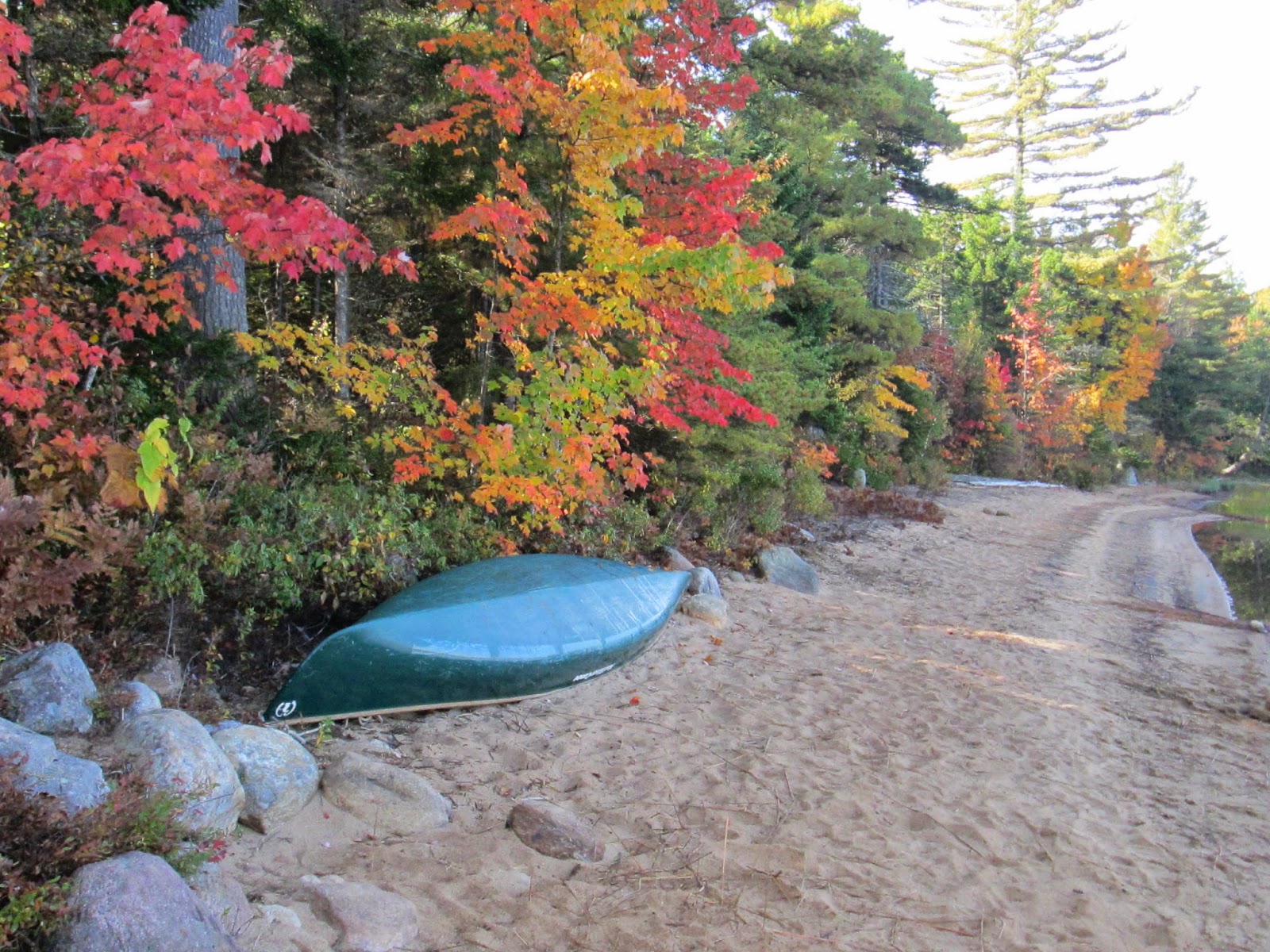
The strip of beach at our campsite.
Canoeing on Single Shanty Brook - accomplished somewhat warily, as this was where the moose headed.
Sadly, we were so busy scrambling over a number of beaver damns that I didn't take any pictures of them.


Moose tracks
That little sliver of beach just right of the center of the photo was the site of the moose tracks above.
This was a very short walk from our campsite. 

My shoes drying out after scrambling over beaver damns and the like.
This was at our campsite - look closely and you can see the ropes we used to hang food so bears wouldn't get at it.
I posted several of these photos on Facebook, where people can click on a "like" button.
Based on that informal poll, the above was the most popular picture of the series.

Rich's selection of Lake Lila for camping had two main purposes - both concerned identifying and judging portage sites used for what canoeists call "the Whitney Loop". One was a right of way around a privately owned (and blocked off) portion of Single Shanty book. A recently opened access to Harrington Brook (above - flows into or out of Lake Lila) was the other - but the portage to access it is still under development and too much of a hurdle for aging gentlemen.
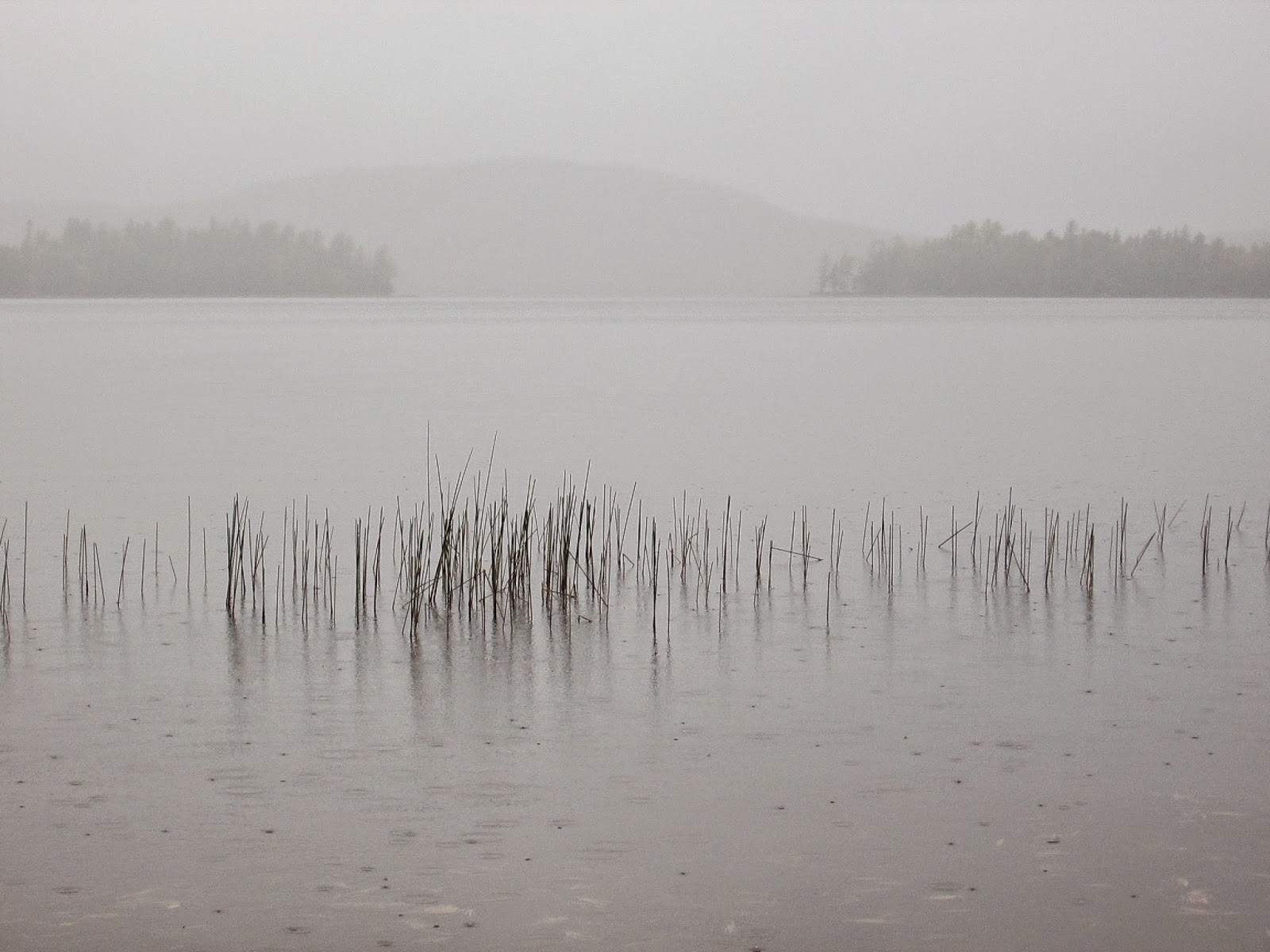
Saturday it rained. A lot. Sometimes quite hard. Made for some good idle time picture taking, though.


On Sunday the rain stopped and the skies cleared. Rich used his radio to get the weather report. On Monday and Tuesday (the day we expected to leave) more storms were expected. Crossing Lake Lila back to the parking lot would be too dangerous, so we decided to break camp while we could. While we were hiking one day, we met a group of guys who had arrived for a few days of camping. They were leaving at the same time. After our first trip to the parking lot, we were on our way back to the put in when they came by carrying our canoe and most of our supplies. Thanks again guys. 


The return to our modern world has been a bit disconcerting as I find myself once again engulfed by the sounds and the noise of other people's living. Thanks, Rich, for keeping after me for all these years to do it, and Thanks for all the trouble you took as part of the process of including me. Next time we've got to get to the top of the mountain, and find that railroad station.

I look at these photos now, sitting at my computer, cars whizzing by in the rain, and they seem a remote dream. A dream I long to dream again.


Friday, July 4, 2014

Going fourth...

It's a rainy, cool July 4th morning here in Brattleboro. I used to really love July the 4ths. Until recent years, that is. A few years ago I had a job running a video store. It was a lot of work, but it was work that I more or less enjoyed, or to be more precise work I didn't mind all that much. I wasn't all that fond of the 12 to 15 hour days, and I recall a minor celebration when I actually got two days off one month. What I very much minded was not being fairly or properly paid, the promised raises that never arrived, etc. I quit that job on a July the 4th the owner made me work - it was going to be my first day off in two months. That impulsive action nearly destroyed my life; I was out of work for a long time. When I found work it was as a cashier in a supermarket where I was required to work on holidays, where I think I got one July the 4th off in five years. That company would schedule people to work for four hours on the fourth. I guess that had some kind of poetic ring to the Belgian corporation which owned the place. Three generations of my family had fought in the American Revolution; the day once held some meaning to me.

Thankfully, the rain this morning isn't another crazy thunderstorm. I like such storms, I like the call and response of streaks of lightning and replying thunder, the sound of the deluge of water cascading off the roof. Unfortunately, my vegetable garden is in a slightly flat depression partway down a hill, which puts it right in the path of rampaging runoff. It's a small veggie planting this year, but twice in the last week storm waters created havoc. (It has been several years since this last occurred.) Yesterday morning I spent a couple of hours fixing up the damage from the second storm. Last night there was another downpour. The rain will keep me out of the garden today, as will work on my radio show tomorrow. I must admit a certain nervousness regarding what I shall find when I get there on Sunday. I distract myself looking for July the 4th images to post from the mass media factories of America, trying not to think of the garden situation as a metaphor. 

Arlene Judge


Ava Gardner

Elizabeth Taylor

My thoughts turn to Americana. This past Monday, I became joyfully immersed in it. I talked a friend into driving two and a half hours upstate to the Shelburne Museum. It is not your everyday day museum. It was created by Electra Havemeyer Webb. Her parents, Louisine Elder and Henery Osborne Hevemeyer were wealthy. Very wealthy. Miss Electra Haveremeyer married Mr. James Watson Webb, a Vandebilt. They were very, very wealthy together.

Louisine and H.O. collected art. Louisine was touring the continent when she became friends with Mary Cassatt, who introduced her to a group of young unappreicateds who would soon be known as Impressionists. The Havemeyers became the first Americans purchasing their work. Most of the collection they acquired was left to New York City's Metropolitan Museum of Art, where their bequest became the foundation of the Impressionist wing. Some of the paintings, however, were left to Electra. They used to adorn the walls of the Havemeyer-Webb apartment at 740 Park Avenue. (If an apartment there becomes available, it is said that you must show a minimum worth of  one hundred million dollars before the cooperative will even talk to you.)

Electra and Louisine Havemeyer by Mary Cassatt


Mrs. Webb was 19 when she began to collect Americana. She loved the large summer estate the family had near Burlington, Vermont, and decided to turn part of it into a museum for her collections. That kind of space was needed. When the last surviving steamship on Lake Champlain went out of business, she bought it and had it moved to the estate. It sits near a lighthouse she purchased. She showed interesting attention to detail - the estate has many wonderful gardens; the plantings by the lighthouse are the kind of rugosa roses one finds at the sea shore near lighthouses (they have an ability to withstand salt air).


The Ticonderoga is the only surviving vertical beam sidewheel steamship.
It is 200 feet long, and weighs 892 tons.
Just past the steamship were these trees - neither my friend (a college professor) nor myself have any idea what they are - please let me know if you do:
 
Blogger has suddenly decided that I shouldn't use the "caption" function - if I try, it deletes the picture. So... just a few steps further and one finds this giant chair:
 
 
(And, in case you are wondering, yes, that is your correspondent taking a break and sitting down.)
 
Mrs. Webb saved one local old Shelburne building from demolition, moved it to the estate, and reused it for her collection of the contents of a circa 1840's General Store, Post Office, Barber Shop and Apothecary. (There is a similar era dentist office on the second floor.) She occasionally bought the collections of others. Next to the barber shop is a room with over 300 straight razors, the collection of a wealthy lawyer.  I didn't take any pictures of the store (I was often too overwhelmed to think of it) but I did take a few in the apothecary.


When I commented on the placement of a couple of objects amusingly displayed in the store, the docent noted that they were "right where Mrs. Webb put them".
 
She also saved a local meeting house and had it moved to the grounds. It houses a collection of Vermont music.
 
She had a small pond installed next to the meeting house:
 
Elsewhere on the property are an old train station (with a 10 wheel steam locomotive), a carousel, a sawmill, a covered bridge, collections of carriages, Conestoga wagons, stagecoaches, hand carved circus miniatures, a jailhouse, textiles (a huge quilt collection), weathervanes, hunting decoys, an  1840's smokehouse, a Shaker shed, a round barn, a worker's stone cottage, and much, much more.

On the property, as a tribute to Mrs. Webb, the family built a reproduction of a fairly un-Vermont Greek Revival Vermont building she admired. In it they put five intact rooms from the Park Avenue digs. The rooms are stunning. The library, for instance, utilized dark wood moldings and black leather wallpaper. (I think I swooned at that point.) Throughout the rooms are the paintings Mrs. Webb's parents left her. Two Rembrandts, Corot, I think there was an El Greco, etc. In a basement room are bronze sculptures by many artists including Degas and Frederick Remington. A number of painting are not in the apartments at present - and therein lies the reason for this trip.

A new building on the estate currently has a temporary museum styled exhibition of the Impressionist holdings, punningly titled "In a New Light". Five or six Monets, several Manets, Degas, Corot, Cassatt. Even the doorway to the exhibit held promise (the Monet which was the source for this image in on display):


The first thing visible upon entering was Monet's "Le Pont, Amersterdam". Just to its left and several feet back was a large photograph of the actual scene. It was very interesting to note that Monet moved buildings and objects a bit to paint what he saw.


One Monet in particular haunts me, not quite to the point of obsession. The reproduction of it does not catch the colors at all. What appears here as a sort of reddish haze was actually sort of, well, not quite chartreuse, not yellow, but definitely early morning light through fog. I think the problem may be that this "Church at Vernon through fog" (near his home at Giverny) is a view Monet painted many times. I wonder if the online reproductions of the painting owned by Mrs. Webb is the same as the one on exhibit.


Blogger and my photo program are both acting up, which may be a last gasp of Mercury retrograde, or the electronics' method of telling me this post is too long, or contains too many graphics, so to rush to a finish...

The Cassatt at the beginning of this essay is also on display, along with several other pieces which I recognized from books, and a few I'd never seen before. I must post this one more, simply because its colors were so stunning, a Degas (what was it with Degas and ballerinas anyway? Maybe he just wanted to try on a tutu?) :


The exhibit was clever, stunningly beautiful, and the works are still in my mind's eye four days later. There was so much to see...

I must go back there soon.


Monday, April 1, 2013

The April Fool

Most of my morning has been spent working on this post. Everything looked great, lined up the way I wanted, etc. That was in the Chrome browser that Blogger allegedly prefers. When I looked at it in the Internet Explorer Web Browser, it was a bit of a mess. I've spent two hours fighting to get the text and photos to line up properly. And I just can't seem to win this one. Sorry, I have other things to do and I'm leaving it the way it is.


The morning was appropriately groggy. So was I. The very first email I opened contained news that at the last minute the Vermont Views website, which was listing our community radio station (which I run) as "non-profit of the month" had changed its mind. As I sank into a resigned sigh, the words "April Fool!" entered in my consciousness. There was an audible low guttural growl which emerged from somewhere within my being. It's April. The poet called it "the cruelest month". The poet may have been right.

Over the last two weeks, I've started many a post for the blog, only to abandon them all for various reasons. I had a cataract removed and was laid low for three days by reactions to the surgery. One partial post was forsaken when there were problems at the radio station which resulted in the rest of my day, and most of the next, being spent in email correspondence. I no longer feel in control of my time. I wonder if I ever really was.


Unpacking at the new WVEW studio
Yesterday was Easter. I became a bit lost in reverie. I spent most of last Easter working with the radio station's engineer wiring our new studio It had been almost a year since the fire at the Brooks House which had taken us off the air.
Tuesday, April 10th, 2012 - logging into a computer to
turn on the transmitter and return WVEW to the air. 
We lost everything in the fire - our transmitter was in the studio and our antenna was on the roof. When something like that happens, the station is given one year to get back on the air or lose its broadcast license. Before we left the studio that day, I logged onto one of our new computers and used it to turn on our new transmitter which was now located (with our antenna) at a school on a hill on the outskirts of town. For a few brief minutes, we were on the air. I called Laura over at Austanspace and asked her to tune us in. She heard us. It was real, it worked. While we were working in the studio, the Easter Zombie Walk made its way through downtown. It's an annual local tradition. I hope it was held this year, I haven't been able to find anything on it - I had wanted to go out and photograph it. I made my way out to Austanspace's Shire for Easter dinner. That morning, I'd also put up an Easter blog post which addressed my love for those absurd biblical era movie spectaculars. I'd intended to do another one this year. How on earth did I get all that done? And that list of accomplishment is decidedly meager compared to what I used to accomplish on any given day  during my years in New York City. At any rate, two days later, after calling an early halt to the station's Board meeting, I ushered the Board members into our new studio, logged in once more to the transmitter, and returned our station to broadcast mode. This year, I accomplished - nothing much. And I was busy from the moment I got up until the moment I went to bed.

"Jubilee" Jim Fisk
Today is the birthday of James (Jubilee Jim) Fisk. He was one of the Robber Barons of the Gilded Age. Born on the other side of the state, his family moved to Brattleboro when he was a child. His father became the owner and manager of a hotel on the corner of Main and Elliot Streets, known as the Revere House, in the days when Brattleboro was a resort town famous for its "water cure". At the age of 15, he ran away and joined the circus. There are reports that he made a fair amount of money by smuggling cotton during the US Civil War. He became a stockbroker working in the office of Daniel Drew, another famous thief of the financial world. (Drew's money founded a Methodist Seminary which expanded to become Drew University, which I attended in 1968-1969.) Daniel Drew was the kind of guy who used to have his cattle drink water to increase their weight just before their price per pound sale. His shady deals became known for using phony and unauthorized stocks, thereby lowering their value. Such stock were soon called "watered down" in his dubious honor.

At the offices of Daniel Drew, Jim Fiske hooked up with Jay Gould. Together they assisted Drew in manipulating the price of Erie Railroad stock, which they swindled away from Cornelius Vanderbilt. They eventually swindled the Erie away from Drew for good measure. They were openly allied with New York City's notoriously corrupt mayor "Boss" Tweed in the bribing of judges and legislatures. They also caused a financial panic which ruined many investors when they convinced President Grant to purchase and hold on to gold; they had the United States Assistant Treasurer in on the deal while they manipulated the price. For their offices, Gould and Fiske bought the Pike Opera House building at 23rd Street and 8th Avenue in NYC.

Samuel Pike had purchased much of the old Clement Clark Moore estate and built upon it a five story opulent 1,800 seat opera house which cost over a million dollars, unheard of at the time. Although the area quickly became a theater district, Pike was never able to lure patrons away from the Academy of Music on 14th Street. Within a year of its opening, Pike closed it. Fisk and Gould bought it and spent another million renovating the building, renamed it the "Grand Opera House", and became theatrical impresarios as well as financiers.

Pike's Opera House


Josie Mansfield
Now, Fisk had married young, and lived apart from his wife. She stayed in Boston with a close female companion. He also purchased a building close to the Opera House and had a secret tunnel built to connect the two. The apartment was for his mistress, Josie Mansfield, an actress.

Edward Stokes


  Mansfield's affections were soon shared with one of  Fisk's employees, Edward Stokes.  Stokes left his wife and children and moved in with her. Together, they attempted to bribe Fisk through the use of letters which detailed some of his underhanded dealings.  Fisk refused to pay up, and started a public relations battle. Stokes was arrested on charges of embezzlement. (It's a long story.) One year to the day of his arrest later, nearly bankrupt and ruined, Stokes shot and killed Jubilee Jim Fisk on the staircase of the Grand Central Hotel. Fisk was 36 years old.

Fisk's body was brought back to Brattleboro for burial in the Prospect Hill cemetery where a large monument was erected to his memory. The monument's central stone is surrounded by four scandalously underdressed (i.e. bare breasted) women, each of whom holds something connected to Mr. Fisk. One holds pieces of railroad track. One, a money bag. Another holds a steamship (another Fisk story). The last holds an emblem of the Opera House.

Fisk's story became the subject of a 1937 movie, "The Toast of New York", bears a great resemblance to part of the plot for the movie "Citizen Kane", and was the subject of several best selling books. Edward Stokes served four years of his prison term before being paroled. Fisk had given freely to charity and was in held in esteem by many - upon his release, there were numerous threats made against Stokes who spent the rest of his life looking over his shoulder and feeling hunted. Fisk's wife died in poverty in Boston. Josie Mansfield made her way to Paris where she married before returning to the states. The rest of her story is unknown. She was rumored to have lived under assumed names in Boston, and in New Jersey where she allegedly died, as per a report in the New York Times. There is one published report that she found her way back to Paris where she died at the American Hospital. There are also newspaper reports that, paralyzed and in dire poverty, she entered a convent in South Dakota to avoid the poorhouse, passed and was buried in an unmarked grave.

The Grand Opera House puttered on for many years, never very successfully. It was purchased and turned into a movie theatre, the RKO Grand in 1938. It continued operating until 1960 when it was  closed, slated for demolition when the Ladies' Garment Union began  redevelopment of the area into the Penn South residential apartments for union members and their families. Two weeks later, it burned to the ground. It was eventually replaced with a nondescript three story office building, the memories of Robber Barons, the Grand Opera House, Jubilee Jim, his mistress, and the Gilded Age long gone.

A current view of the corner of 23rd Street and 8th Aveue, New York City