Sometimes it is best to not read the news, and to not drift along in the web. This morning, as I was checking my email, I clicked a link to a Facebook post with a picture of my nephew that I wanted to see. I noticed that Facebook's ads, which are targeted based on what one reads and which pages one visits, are getting a little more interesting. One of today's was for Greg Palast's new comic book! Wait - a Greg Palast comic book? Yeah, I clicked on it.
Palast is one of the few reporters who investigated the theft of the 2000 U.S. election by illegally removing people from the voting rolls, a subject he revisited after the election of 2004. In his advertising for the comic, he quotes right wing win-at-all-costs operative Karl Rove's June 2011 Wall Street Journal article (“Why Obama Is Likely to Lose in 2012”) dictum that “If their [black voters’] share of the turnout drops just one point in North Carolina, Mr. Obama’s 2008 winning margin there is wiped out two and a half times over.” You can see where this is going. I moved on, only to find a Reuters News Service story which states that new laws in 23 of our 50 states could prevent up to 10 million Hispanic voters from registering or voting via picture ID checks, phony illegal immigrant claims and etcetera. (Latinos comprise more than 10% of US voters.) Experiencing a sudden chill I blamed on the cool morning, I moved on.
Oh, look, here's another Reuters article investigating how many Americans are not counted as unemployed because they have given up looking for work. Evidently, if they were counted the August unemployment figure would change from 8.1% of the country to 10.5%. Hey, what's another four million unemployed?
Speaking of which, Yahoo is reporting on a 19 year old unemployed male who stole a rare coin collection and then spent the coins at their face value for pizza and a movie for his pregnant girlfriend. He used a quarter that could be worth up to $18,000.00!
And then there's the story of a double amputee in a wheelchair who was shot to death in close quarters by a cop who thought that the pen the guy held was a gun.
And it turns out that the lining of soup cans contains so much of a harmful chemical known as BPA that a direct correlation has been shown in people with brain cancer. It has also been linked to breast cancer, prostate cancer, and diabetes. The Food and Drug administration refuses to ban it, though, so it must be okay - right?
Awww, here's some good news for the day - a baby goat is saved from drowning by a hero pig!
But the best news of all is that "Heaven's Gate" has been restored and is being shown at the Venice Film Festival where it is now garnering praise. When it was made back in 1979 and 1980, its cost overruns nearly destroyed United Artists, which was soon gobbled up by MGM - itself about to be taken over by an evil financier eager to get his hands on that studio's prime L.A. real estate. The original negative was destroyed in a studio attempt at a recut. And it has been reported that an executive from the office of the new President, Ronald Reagan, told Hollywood executives that there were to be no more movies critical of United States history, thank you very much.
"Heaven's Gate", finally earning respect.
The film did pretty much end the careers of its director Michael Chimino ("The Deer Hunter"), and leading man Kris Kristofferson. It was long, close to four hours long. I was in the film business then, and saw the complete uncut version. It had its problems, including telling its story in a somewhat elliptical non-linear fashion, but I liked it. I was in a distinct minority. Many felt its theme was unappealing - it concerned the Johnson County War (Wyoming, 1892) in which wealthy cattle barons - with state approval - used hired guns to kill poor European immigrant farmers in order to keep grazing land from being settled. Eventually, the President of the United States had to send in the Cavalry - literally. The Cavalry, by the way, were there to save the mercenaries who had been trapped by the poor farmers.
Killing the poor? Could never happen, right? Now we just find ways to stop them from voting. And working. And make them eat canned soup. Cue the hero pig!
When I read the article which started Sunday's post, and which stated that the Strand and Moorlyn Theatres on the Ocean City, NJ boardwalk may have closed for good due to the cost of digital conversion, I found that I had to do a little more digging in my files, memories, and on the internet. I'd known that the Strand had been multiplexed, and I'd already researched the fate of the other Boardwalk movie theaters well over a year ago. But I wanted to know a little more - something wasn't sitting quite right. So here is what I've managed to dig up and my impressions of it all:
When I lived there, there were three other movie houses on the boardwalk. They were all pretty much big old barns, harkening back to the days before tv, when filling a thousand plus seats a couple of times a night wasn't all that difficult for a hot title - everyone went to the movies then. In the 1970's, the economics of running such places tended towards futility. Aside from the Strand, there was also the Moorlyn, the Village, and the Surf.
The Surf as it is today, with a small marquee to list its shops.
There isn't much out there about the Surf. The other three venues were owned by the Shriver family, but the Surf was owned by someone else. I can't even find pictures from its days as a movie house. I don't know what happened or when, but it seems like it was the first to go. Built as a venue for stage shows and vaudeville in the early 1900's, the building now houses a mini-mart of stores. It was where I saw "Woodstock" on its original release, projected on a screen so large that any of the three side by side panels the movie often used would easily dwarf most screens of our day. I seem to recall it being twinned early on, and that it stayed open at least one winter.
It was there in 1970 that I saw a double bill, a re-issue,
of 'Gold Diggers of 1935', and 'Footlight Parade', two of those slightly insane black and white Busby Berkeley 1930's musicals. The Gold Diggers movie includes the stunning "Lullaby of Broadway" number, one of the all time great musical hallucinations. By the time I left the theater for my walk home along a deserted boardwalk, I expected the path before me, as well as the nearby buildings, to turn into hundreds of dancing girls swirling in geometric patterns.
If my memory about the Surf being twinned is correct, then it must have been owned by the Frank family as part of their Philadelphia and Southern New Jersey circuit of theaters. The Franks get the dubious credit for creating the first twinned cinema and the multiplex.
And I definitely remember that the Franks and the Shrivers did not get along.
The other three venues were all owned by the Shriver family. Shrivers Salt Water Taffy, as well as their fudge, and the factory store are a longtime mainstay of the boardwalk. In fact, it was the first buisness on the boardwalk. It is also the home of the best salt water taffy I've ever had to this day. If you drive across the main bridge to the island and continue directly to the Boardwalk, on your right will be the Strand and on your left is Shrivers. The family sold off the taffy business in 1959, but kept the theaters, several other businesses, and a good deal of prime real estate.
The Ocean City Boardwalk in 1964
The last of the Shrivers was Mrs. Helen Shriver Schilling. She, more than anyone else, was responsible for maintaining much of the older more genteel character of Ocean City and the boardwalk. But Ocean City fell into the hands of people who changed zoning regulations that allowed high rises in, and etc. They destroyed Ocean City, and turned it into an atmosphere redolent of cheap honky-tonks. In 1989, Mrs. Schilling sold the theaters. Her one proviso was that they not be sold to the Frank family, but to someone who would preserve them. They sold for over three million dollars. The buyer did not show up at the closing It later turned out that the Franks had bought the theaters through subterfuge. When they trashed the Strand, it was one of the Frank family who personally ripped down the silk main curtain with the image of Poseidon, tore it to shreds, and threw it into a dumpster behind the theater.
Somewhere along the way the Moorlyn was turned into a twin. In my day, it had a glorious neon marquee, which was preserved even after the initial conversion.
In the 1920's and 1930's, the Moorlyn had an upstairs ballroom. It had a vaudeville stage where the likes of W.C. Fields used to appear. Eventually, the Franks tore it all down and replaced it with a multiplex, with expensive apartments where the stage and ballroom had been/ Here's the new building on the Boardwalk, with a type of signage Mrs. Schilling would have abhorred:
Saddest of all is the fate of the Village Theater. The Village started out as Doughty's pier, sticking out into the ocean. It had a bowling alley, and was home to vaudeville and silent movies. Over the years, the ocean retreated. In 1927, much of that portion of the Boardwalk was destroyed in a terrible fire - but the pier survived. The new boardwalk was built where the ocean had been, and the entrance to the pier was changed to what had been the building's rear. For the remodeling work the theater, now situated alongside a boardwalk off-ramp, had sound equipment installed. An ingenious facade covered the awkward fit of the pier and its new circumstances, designed to resemble the buildings of an old fishing village.
The Village interior made geart use of wood. It was the smallest of the Shriver's Ocean City theaters, but it was a prestige house. It operated continuously until the sale to the Frank family in 1989. In June of 1990, it burned to the ground.
When Mrs. Schilling died, she left the town land she owned on the ocean side of the boardwalk, with a proviso that it never be built upon. The town is now trying to change that. She also left several lots near the boardwalk that are used for visitor parking, and did it in a way that the town hasn't been able to build there yet. And, she had set up her her estate in such a way that executors were instructed to offer the long time tenants of her boardwalk store front buildings a chance to buy their spaces as a co-op. All but one did. They were thus preserved and saved from the garish primary colors cheap plastic world that the boardwalk became; a gentle reminder of a time when people cared about their community, when life was about more than a quick buck.
My first music reproduction device was a 78rpm kid's record player made out of tin.
As a child, I had a record player exactly like this one.
Before long records changed to 45rpm, then to 33 1/3 long playing lps. Soon there was high fidelity and then there was stereo. All that in the space of 10 years Flash forward past home tape recorders, cassettes and the birth of mix tapes (sigh), CDs with clean but cold sound, to mp3s which allowed thousands of songs to be stored on a device the size of a slightly thick playing card, to mp3s which must be paid for and which have licensing and copy protections in them so you can't share them with your friends. It's a wonder they haven't come up with a way to make you pay every time you play a particular song.
TV in my lifetime changed from a small (except we didn't know it was small then) black and white flickering picture to large 19 inch sets that were designed as furniture for the living room. Color arrived in the mid to late 1960's (now there's a loaded statement).
Sometime in the early 1980's, I can remember walking the streets of Greenwich Village the night the Public Broadcasting Service presented a Metropolitan Opera performance "simulcast" in stereo on local radio stations and hearing what was it, La Boheme?, wafting through the windows of every single block on my way home. Then ABC began simulcasting music videos late on Friday nights. It wasn't long before tv sets had stereo built in. Along the way, there was BetaMax, VHS, Laser Discs, DVDs, and now we have available very large wall sized flat screen high definition surround sound stereo devices that mimic and rival the quality of movie theaters. And there's the rub.
Over the years, film has come in many sizes and formats. But it was film, celluloid. The images would be projected onto large screens, 20 to 40 feet wide. Those images had a special kind of magic. They captured and inspired our imaginations. And those images have changed over the years. Film stock used to be nitrate, which gave a special glow.
35mm nitrate image from the silent German film "Metropolis"
Nitrate film stock was unstable and flammable. Safety stock came in, but the rich blacks and silver glow of the images were gone. Stunning technicolor images (also with rich blacks) gave way to more economical and less complicated Eastman stock and its imitators, in which the colors were more subdued and quickly faded. There have been any number of other changes, from the size of the film itself to special lenses for widescreen, stereo, multi-channel stereo Sensurround, various 3D systems, and etc.With each change, the way we perceive the image itself, and the story we are watching, has changed. But the image was still on celluloid.
Many movie theaters now project digital images. Celluloid is being phased out. This was all predictable. Indeed, the only surprise to me is that it took so long. When I was put out of a job in film distribution in the mid 1990's, I fully expected celluloid to be completely gone within 10 years. But the time is now. Movie theaters are already having problems getting 35mm prints. There is about a year left. Theaters must either pay about $70,000.00 per screen to covert to digital, or they will find themselves out of business.
I can't begin to estimate how many 35mm prints in cans like this I've slung around over the years
Most film images wash over you at the rate of 24 frames per second. There is a momentary display of a picture in a concrete all there at once image, interspersed by moments of darkness as a flywheel blocks the light while the next picture is brought before the light source, aperture, and lens. Persistence of vision creates the moving image. (Ingmar Bergman used to note that people seeing his movies were really paying to sit in 20 minutes of darkness. He wasn't talking about his themes.) Digital images, on the other hand, are based on a scan line. One line is filled in by electrons hitting a display, skipping a line, going on to the next line, skipping a line all the way down an image. The electron beam then goes back and fills in the missing lines. Even though this happens very rapidly, the display never has a complete image on it - it is a mental process which puts this picture together. That process puts the viewer into an alpha state, accepting what is shown in a much more uncritical and relaxed fashion. This was detailed in a mid 1970s book "Four Arguments for the Elimination of Television", which claimed that tv was, therefore, lulling people into passivity ripe for autocratic rule. This effect is not based on content - it is based on the psychological effects of watching tv - the problem here is the medium itself.
Aside from those scary implications, part of the sadness I feel over this change concerns the auditorium experience of going to the movies. Once, there were giant screens fronting a sea of seats in "an acre of dreams". As television took hold, the theaters became smaller, there were less seats, the auditoriums were less grand. When I was a kid, one entered the theater to music playing softly in the background. There were curtains in front of the screen. At the appointed time, the house lights would dim, the music would swell, colored lights would engulf the main curtain which would open as images began to appear on the screen. An inner curtain would close after the coming attractions, newsreels, cartoons and short subjects and reopen for the feature. Movie going was an experience, a shared worship. Today's smaller auditoriums still offer a shared experience, but the ceremony, the ritual of presentation, is gone. Most of the big old houses have been multiplexed, losing their balconies, their size, their prestige and their showmanship in the process. (Check out my post on one of the great movie palaces, The Roxy.)
I could go on, but I won't. This article started because I looked something up. I stumbled upon a news story that the Strand Theatre in Ocean City, New Jersey might close for good - unable to afford the cost of digital conversion. It currently has five screens and is a shadow of its former self. I saw many a movie there before it was multiplexed. It was one of the homes, nay, the temples, of my celluloid dreams.
The Strand as it is now.
Back in its glory days when the Strand was new.
One entered through those doors, walked down the hallway past illuminated pictures of movie stars (concession stand on the photo left, which would have been on the right as you entered.)
Even the back of the auditorium was a grand and huge space. Well, the Strand did seat 1,200 after all.
As you entered the auditorium, art deco lighting greeted you.
The auditorium
Close up of the design on the main curtain
The Strand Theater has been listed for sale. I want it to survive, but its time has gone and it really ceased to exist years ago. In memory (was it real?) I see myself saunter past on a rainy windswept night, the glow of light reflected on the wet boardwalk, lost forever in my own noir world of blue neon dreams.
After taking a lovely few days off from work as I turned 62, I returned to my rewarding and fulfilling career position as a supermarket cashier full of pep and vigor. Less than a week later, I have returned to a life of constant backache, arthritic knee pain which leaves me walking in hobbled fashion, flatulence which would offend a skunk, and as still yet another indignity have now come down with something nasty. I had to call in sick today. I didn't want to, I have little in the way of provisions and had planned on stocking the larder after my four hours of toil in the fields of Mammon. It is also quite within the realm of possibility that I could be fired for "calling in", an odd bit of terminology which should really be "calling out".
Actually, this image is somewhat inaccurate. I refuse to go into further de-tail
At the very least, at some point upon my return, I will be taken off the sales floor and given a lecture and forced to sign paperwork stating that I understand that my actions inconvenienced others and adversely affected the morale of my co-workers. I suppose I should have gone in sick giving this cold a chance to spread around to those who haven't come down with it yet (many already have it and have already inconvenienced and affected the morale of their co-workers), asked to run to the bathroom every 10 to 20 minutes and so on and so forth. Just as a by the by, there have been times when I have asked to go to the bathroom and been told no - I have had to remind the supervisors that their denial is illegal (this happens to others as well, not just myself). I doubt that the customers would appreciate the results of a lengthy denial of bathroom "privileges" at the moment. The corporate environment in which I work is badly in need of a worker's union. Of course, if that were to be mentioned out loud, or posted where such sentiment could be easily seen or found, the person expressing such a thought would quickly find themselves dismissed. Not for using the word "union", of course, but they would find something. (I immediately recall two bookkeepers in a row who complained about their supervisor, both of whom were dismissed when the cash drawers were found to be exactly one hundred dollars short.) The workers at the local Food Co-op have once again started the struggle to form a union. More power to them. Literally.
On another eqully distressing note, ever since my new internet service was hooked up, my computer has been misbehaving. It no longer "sleeps" - the monitor will turn off but the computer itself returns to its "awake" state immediately. After a couple of hours, it will turn the monitor back on. I wonder what it is up to. Is it trying to catch up on all the news it missed? Have we caught the same virus? Is it having an affair with a computer half way around the world? I do hope it stops this and returns to its normal behavior soon. I shudder to think what will happen if our bond of trust is broken.
For the last two days, my new internet provider finally displayed my location (on the globe at the top right of this page) as being within the state of Vermont. The only problem is that both of the towns listed (Stowe and Barre) are quite some distance from here. Today I'm showing up as back in New Hampshire. Needless to say, I find this annoying. It really isn't a matter of much consequence, but it is indicative of the state of the world in general that something that should be so simple has become so f***ed up.
Yesterday, I began my 63rd year on life on this planet in this identity and body. Yes, I suppose that's weirdly specific, but ya never know when such clarity will be needed (or useful)... Not that I've ever thought that I was an alien from another world who somehow got trapped here. Well, okay, but that wasn't until I was in my 30s and Reagan was President.
The initial construct of this post - oh, hell, that's tortured phrasing. You see, I have this thing about starting a sentence or paragraph with "I". It's time to get over that one. I originally started this post yesterday, with a note that I was born 62 years ago in a hospital in the southern part of the state of New Jersey. I named names and places. Then I thought that I might be giving away too much information which might lead to identity theft. Not that I have anything much for anyone to steal. I don't want or use credit cards. I have almost no money for anyone to take, although if someone did grab the rent money out of my bank account it would provide me with huge problems which would initiate one of those dominoes falling sequences that would be awesome to behold but no fun to live. My basic intention was to mention that I was born in a hospital. I may have been the first person in my family to have that experience. My older brother was born at a midwife's house in my hometown.
When I first became obsessed with movies, I was intensely focused on the silent film era. I remember a discussion once with my grandmother about the silent Lon Chaney version of "The Phantom of the Opera". She told me how she had seen it when she was young and how it had frightened her. On reflection, she wasn't all that young - she would have been about 25 when it played my hometown. That memory has popped up from time to time, and at one point in my life started me thinking about the changes my grandmother had seen. She was born on a farm. She once told me that as a young girl on her way to bed each evening, it was one of her chores to trim the wicks of the candles and oil lamps. Her lifetime spanned an era in which electricity arrived in people's homes, to cars, airplanes, world wars, telephones, radio, movies, television, and men walking on the moon. As for my own humble self, I always felt like Rosencrantz and Guildenstern waiting around while nothing much happened - except that they were unaware that they were minor characters in the story of Hamlet, which was being played out around them.
So, a few years ago, I began to take stock....
Arrrgggghh. I had included Vladimir and Estragon in the text above, but found that it muddied the thought being expressed and deleted them. To make certain that I had the spelling right, I had looked them up and simply cut and pasted the names into this text. They appeared n a different font. I was able to fix that, but every new word typed used the font change and I've now spent at least 15 minutes trying to get things back to where they were with the original settings. None of the choices Blogger has for fonts matches the font being used. Trying the "default" font comes close, but the spacing is different and it is very noticeable - at least in draft mode. When I look at the post in "Preview", the affected text has taken on a different color and can barely be seen. I managed to fix it - the solution was in copying the text, stripping it of control codes, deleting the post, and starting a new post into which I pasted the cleaned text. Something that should be so simple....
And maybe that's my point. I've lived in an era in which great inventions changed the way we live - but each modification since has made things more complex - often to the point that the inventions themselves break and/or become unusable or too frustrating to use.
I think I'd better go do something else for awhile. Quem deus vult perdere, dementat prius - and all that. Ya know?
Since my return to internet space the other day, the little globe on the top right hand side of my blog page has shown my connection as originating in New Hampshire. Several different towns in New Hampshire, depending on the day. And some of those towns are over an hour away from Brattleboro.
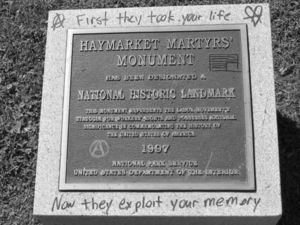
Today is Labor Day. As I am currently on the lower rungs of the economic ladder, I am celebrating the accomplishments of the American Worker by working. Ah yes, the white collars get the day off so they can torture the blue collars who must wait on them or lose their jobs.
Where I work, the wall between the sales floor and the bathrooms and staff break room is covered with framed "diplomas" signifying the completion of various business management courses. One of the 'diplomas' is for "Union Awareness". I well remember that I was personally warned by my department's manager that I might be followed or approached by a union organizer and that I should ignore them and report any such incidents.
Mother Jones talking with the President of the United States from Vermont
May Day (the -real- Labor Day) 1933
Local heroes
Oops - lookit the time - I must go - can't be late - that could get me fired.....
Jeez-us. It's Labor Day weekend already. We had about three days of summer. There was a lot of horrible, hot, humid nastiness which visited and became the guest who wouldn't leave. Was that supposed to be summer in Vermont?
It's been a few years now since I had to put down the Jimmy. The lack of vehicular transport frustrates me quite a bit at this season - it's Fair Time. I used to love the State Fair in Rutland - aside from having a really crappy side show, suitably tacky decrepit rides, extraordinary maple doughnuts (consumed with coffee sweetened with maple sugar, natch!) and some of the best french fries and deep fried onion rings on the planet, that fair had the superbly entertaining Vietnamese Pot Bellied Pig Races. I've no idea where the pictures I took years ago have gotten to. Instead, I'll just have to satisfy myself with a few pics I took with my cheap digital camera a few years back at the Guilford Fair.
Guilford is a small village (or maybe a series of villages) just south of Brattleboro. I'm always amazed when I hear that there are 2,000 people there. It makes me wonder if the count includes all the cows and all the zombies. At any rate, there is an annual Labor Day Fair which is always worth attending as they have a booth with pretty good french fries too.
When you first get to the fair, you get to park in a field alongside this house, which is across the country lane from the fair site (I'd love to explore that house):
As one first enters the site, one sees the area where young riders prepare for their exhibition:
Up the hill at the fair proper is an old barn where the season's crop of veggies are judged:
And of course, the livestock exhibit and competition:
Further up the hill is the midway:
You thought I was kidding about the zombies, didn't you?
Well, you'll have to excuse me now. I'm off to a Labor Day fair where I can have a dance....
(visual distortion at the beginning clears up quickly)