There was a song once called "The Lady Who Swings the Band", performed by Andy Kirk and His 12 Clouds of Joy. The 'Lady' in question was Mary Lou Williams who played a mean boogie woogie as the band's pianist. She also composed and arranged for some of the biggest names in the business. Her husband was touring with his own band when he got the invitation to join Andy Kirk. She took over the band for their rest of their tour before joining her husband. She was 19 at the time.
Mary Lou Williams as photographed by William Gottlieb
There were many women who played in swing bands, and who led swing bands - of both the "all girl" and "all boy" variety. In the volumes of jazz and swing music history, the ladies had, until recently, been left out, forgotten, and omitted - sometimes on purpose.
Today, March the 8th, 2015, is International Women's Day. And this coming Friday, March 13th, is the birthday of Ina Ray Hutton, who led the 'all girl' Melodears in the 1930's, and an 'all boy' Orchestra during WWII (no easy feat as many of the smaller bands closed down due to an inability to keep their musicians who were being drafted). Ina Rae was a blonde bombshell who danced around the stage with a shimmy and a sway that I gather was reminiscent of the first black woman known to have led an all male band, Blanche Calloway.
Blanche Calloway
Ms. Calloway was a fan of hot jazz. After touring as a dancer in an all black musical, she settled in the Chicago of 1927 because that's where the music was. She soon recorded two songs (one 78 record) with the billing of "Blanche Calloway and Her Joy Boys" - which included the young Louis Armstrong. She soon formed her own orchestra using the 'Joy Boys' name. At various times the band included future jazz giants Ben Webster, Cozy Cole, Chick Webb, and Bennie Moten. Ms. Calloway had a wild flamboyant performing style which she taught to her younger brother Cab. Needless to say, being a young black woman in a male dominated profession provided a number of challenges. So did touring the American South, where she was arrested for using a public restroom. One of the musicians who came to her aid was pistol whipped and arrested as well. While they were in jail, someone absconded with the band's money. She sold her yellow Cadillac to raise the funds to get home. At the outbreak of the war, she tried to start another band - this one with women musicians, but bookings were scarce and she retied form the business. In Florida she took up politics, and worked as a disc jockey for a radio station where she spent 20 years as program manager.
Ina Ray Hutton was a singer and dancer who appeared on Broadway in both the George White Scandals and the Ziegfeld Follies. In 1934 she was approached by music publisher Irving Mills and asked to lead an all girl band called the Melodears. They were hugely popular, and appeared in many "soundies" and musical short subjects. Here's a prime example:
The Melodears disbanded in 1939. At the outbreak of the war, Ms. Hutton started an all male orchestra which was also hugely popular. Over the last several years, there has been a great deal of research claiming to prove that Ms. Hutton and her sister June
(who replaced Jo Stafford in the Pied Pipers) were of African American descent, and passing for white. One member of the family gave an interview in which she stated that Ms. Hutton's mother had told her that the family was Irish/Scots and Cherokee. Sadly, the was she or wasn't she ruckus has come to overshadow Ms. Hutton's accomplishments - which included a lot of damned good music.
In Mississippi there existed the Piney Woods County Life School, which educated orphans and poor children from their area. The school's founder heard Ina Ray Hutton and the Melodears and decided to create and all girl swing band to help the school raise money. The only band which could be said to be 'girls' came into being as The International Sweethearts of Rhythm. The Sweethearts turned professional and added a few of the top women musicians in the country - including Anna Mae Winburn who had been leading an all male band. The Sweethearts were an integrated band of African Americans, Asians, Caucasians, Latinas, Mexicans, and Indian. They were one of the best swing congregations out there. When they competed in a battle of the bands with Erskine Hawkins, 10,000 listeners declared the Sweethearts the winners. It was not unusual to see some of the top bandleaders of the day listening to them from the wings during performances. Those performances, by the way, took place in mostly African American venues. Touring the South provided extra problems - the lighter skinned women had to use makeup to darken up lest they be arrested for being whites performing on the same stage as blacks. Two of the best arrangers in the business worked for them - and quit in protest when they saw how the women were being treated and found out how badly they were being paid. After they performed on the war era 'for the soldiers' Jubilee radio program, demands for more came pouring in. In 1945, the Sweethearts became the first black women to be presented by the USO as they toured army camps in France and Germany. After the war, the change in musical tastes made making a living even more difficult, and the Sweethearts disbanded. When the ladies tried to retire, they discovered the money withheld for social security had never been paid to Uncle Sam. The band slipped into the obscurity of the footnote. In 1980, Marian McPartland convinced a jazz festival to reunite the Sweethearts. Feminists and musicians took up their cause. A popular documentary on the band premiered in 1986 at the New York Film Festival. The Sweethearts first trumpet, Tiny Davis, and their drummer Ruby Lucas, were the subjects of another documentary, 'Hell Drivin' Women'. Only a couple of sides were ever recorded. What remains are bits of film (often incomplete fragments) and a few radio shows.
Lil Hardin Armstrong
Lil Hardin was a pianist working in Chicago in the 1920's when King Oliver came to town. After hearing her perform, he asked her to sit in with the band. It wasn't long before she became a part of the band. According to her own account, she was, at first unimpressed by a young coronet player who was "too country". She took him under her wing, taught him how to dress and present himself to the public. She ended up being the pianist, composer, and arranger for many of his early recordings. She also married him, becoming Mrs. Louis Armstrong. After they separated, she formed an 'all girl' orchestra, followed by one with both female and male musicians. She faded from public view, emerging every now and then with a band or as a soloist. She planned to release an autobiography, but decided to shelve work on it lest it embarrass her ex. When Mr. Armstrong died, she was by all accounts devastated. A month later, while performing at a memorial concert, she collapsed and died. Her papers and autobiography disappeared.
Valaida Snow
While all of these ladies deserve to have their stories told (and their music played) I've never understood why Valaida Snow hasn't been the subject of a movie or stage show. Louis Armstrong may have tried to hire Tiny Davis away from the Sweethearts (she chose to stay), but it was Valaida Snow whom he described as the second best jazz trumpet player in the business (after himself).
A multi-instrumentalist singer and dancer, Ms. Snow was performing professionally by the time she was 15. The press loved her, and the audiences loved her. She toured the US, Europe, China, and became the toast of London and Paris. Her good friend Josephine Baker tried to convince her to return to the US as war clouds gathered, but Ms. Snow didn't take the advice. She was arrested as a drug addict (and according to some accounts for being a lesbian) by the Nazis. She may have been a prisoner in a concentration camp. There are stories. Ms. Snow, however, was known for telling stories as flamboyant as her personality. Some researchers claim she was only in a Danish prison and the stories were fabrication. Whatever really happened, she never recovered from the experience. In the 1950's, she began an attempt to regain her career. She was backstage at the Palace Theater when she collapsed and died from a brain hemorrhage.
Valaida Snow and one of her Orchestras
And there was Dolly Dawn and Her Dawn Patrol. Ms. Dawn was a vocalist who joined George Hall's Taft Hotel Orchestra. Hall was a violinist who didn't play swing; he led an competent but uninspired band. Once Ms. Dawn joined up, their 6 day a week broadcasts became extremely popular. Ms. Dawn soon had a 'band within the band' set up for recordings, released as ""Dolly Dawn and Her Dawn Patrol". With record sales increasing, Hall saw his opportunity to retire from leading the band and took it, turning the band over to Ms. Dawn in a public ceremony at the Roseland Ballroom. The band gained new energy and spirit, recording under the "Dawn Patrol" moniker. It only lasted a year. The war arrived, the draft took many of the musicians, and Ms,. Dawn set out on a solo singing career. During the post war years, she too faded from public view. A 2 disc reissue of her old recordings in 1975 brought her new attention, there was a new album, and she began to perform occasionally in New York clubs.
My radio show this week featured these ladies and their music. It had been a difficult week; by the time I started the show I was exhausted and that problem I have in which thought can't quite translate into coherent speech came by for a visit. Hopefully, listeners will enjoy the music enough that my verbal stumbling won't be of concern.
It's difficult to realize that it has been 15 years. The entirety of it is a heck of a story and begins about 17 years ago, or maybe even 20 years ago , or it could go back as far as 1970 or so, but all that is not relevant to this post. The basic situation is that on Saturday March the 4th, 2000, I was to start my own show on radio free brattleboro. March the 1st was the birthday of Glenn Miller. March the 2nd was the birthday of composer Kurt Weil. I was set to celebrate them both. The rfb studio had just relocated to a shed attached to the basement of a building on Main Street. The entrance required a walk down an alley, along the railroad tracks next to the Connecticut River, and up a specially built lengthy flight of wooden stairs.
The stairs - from a landing half way up the hill.
When I arrived that day, the woman with the show before mine wasn't there. The door was locked. I had no keys. A comedy of errors ensued for over an hour as I attempted to get access (I managed to track down someone who gave me the wrong key - twice!) and finally gave up the attempt. My show, still nameless at the time, debuted on March 11th.
The old radio free brattleboro studio. Computers hadn't yet entered into the studio mix,
there was no streaming internet, etc. Heck the internet was only a couple of years old.
Home made CD's had just become possible. Dave Longsmith suggested raising money
by selling rejected home burns as coasters we would call 'recycled radio'.
I hollered "That's It". And that's how my show got its name.
Seven years later, radio free brattleboro had its equipment seized by the FCC while we were broadcasting under the protection of a Federal judge. (Like I said, it's a heck of a story.) In the meantime, the FCC had been embarrassed into giving out low power licenses again, which they hadn't done for over 20 years. One went to a new community radio station set up in Brattleboro, WVEW-lp. Before long I was back in my comfy Saturday night timeslot. Five years later there was a fire in the building which housed our studio, transmitter, and antenna. The station was wiped out. When that happens, the FCC gives license holders one year to get back on the air. The station had been managed by its staff. When the work of returning to the air started, a dissident group of the membership took over the station. Things got nasty, but the folks who started the station eventually regained control; we made it back on the air with one week to spare.
While it might have been better to note my show's anniversary (15 years? Really?) next Saturday, March 7th, I have other intentions for that program. March the 8th is International Women's Day, so the night before is an excellent time to produce another version of a show I've done several times over the years dedicated to the women who led swing bands.
Blogger is giving me all kinds of problems, changing the colors of text, refusing to cooperate, and generally behaving like a spoiled child intent on having its way. It must have been associating with Facebook. So I'll just post a few newspaper clippings from the first week or so of March 2000, then post last night's show, which finally celebrated the birthdays of Glenn Miller and Kurt Weil.
This was another in the series of shows where I couldn't seem to focus on what I was doing and talk at the same time. Nevertheless, I think it turned out to be an enjoyable show. I hope anyone who listens thinks so too.
One again the week has gotten beyond me. It's now Saturday and I still haven't posted last week's radio show. So of course I'll take the time to write and post on the very morning I usually start going crazy trying to get my show materials prepared.
Our all volunteer radio station is once again staking a claim to the majority of my time. I wasn't in charge, or on the Board, for about a year and a half. I must say, it was refreshing to just do my show and not spend time managing the station and its affairs. During that time, the station seems to have paid many of its bills by selling off all of its extra equipment; turntables, an iMac computer, our photo copy machine, etc. The little disasters which took us off the air for most of a week this past December (just after I returned to the Board and its Presidency) ended up costing us a tidy little amount while increasing our monthly budget just as our insurance went up 25%. With an on air pledge week, we managed to make the large initial insurance premium, and we'll be able to pay the rent and insurance for March but after that.... (I'm aware of what the poet said about April.)
When a previous treasurer used to express his worries about our finances, I always told him to trust to the magic of Community Radio. Somehow everything has always worked out. This time, I'm concerned. Actually, I'm worried. Very worried.
We've managed to pay all of our yearly one shot fees and royalties, so now we can settle down and figure out how we are going to raise a minimum of over $700.00 per month. We're in a town of 12,000 people. There aren't that many businesses to hit up for underwriting; most of them are already suffering from 'support nonprofits' fatigue. I've been heavily involved in this project for a long time. I was directly involved in its creation. I don't want to be the Board President who ends up closing it down.
Last Saturday's show visited the week which included February 22nd, 1945, the date of our featured broadcast from the Victory Parade of Spotlight Bands show. That day the spotlight fell on Frankie Masters and His Orchestra. Masters had a very decent sweet swing organization, basically a society orchestra playing in the ballrooms of swank hotels. He came to fame at the College Inn of Chicago's Hotel Sherman. If the name sounds familiar, it survives in the name of a widely marketed chicken stock originally prepared by the Inn's chef.
Blogger has rearranged these newspaper clippings from that week, and I really don't have time to try to fix it to be the way I want it. Oh, well.
The movies in town on Thursday February the 22nd, 1945 weren't as good as the movies that showed up for the weekend. People forget that in the pre-tv world, movie theaters had one large screen and changed their bills three times a week.
Okay, I have to stop for a moment and insert this reissue coming attraction trailer. "Meet Me In St. Louis" has long been one of my most favorite of movie musicals. In the days before home video, I had the resources to collect film. I had (and still have) my own print of this classic. It's such a lovely valentine to an America that existed only in the collective unconscious of Hollywood and therefore our nation. I could do an entire post about it. I will someday, if I ever get the time.
For more such clippings and various notes about this and that, check out my show's Facebook page. If you don't have a Facebook account, you can access it at this link: https://www.facebook.com/pages/Recycled-Radio/621059471269529
(clicking on a picture in any post opens a slide show.)
If anyone has been following my show based on these posts, please accept my apologies for not getting this done sooner, and so on and so forth. And I hope any listeners enjoy the show.
Looking outside just now, one would be hard pressed to determine that it has stopped snowing. The wind has been gusting, sending billowing clouds of white powder into the air with such force that any view is temporarily obscured by a swirling 'white out'. It has warmed up to a toasty 9 degrees Fahrenheit out there. As I'm fighting off a nasty bug that is 'going around' it's a good day to be inside. It's the final day of Brattleboro's yearly Harris Hill ski jump weekend. It's an event of some renown, attracting international competitors to town. I've always kind of wanted to go and watch the event, but to be honest I just can't see spending $20.00 to stand in a snow covered cornfield to watch someone else have fun.
-------------------------------------------------
Well.
That was fun and a half. Just as I completed the above paragraph, the power went out. It came back on after a few minutes. The computer was booting up when the power went out again, announced by a fear inducing metallic click.
It's fairly interesting to note how quickly my apartment cooled down without heat. The power was out for an hour. When it came back on, I started up the computer and returned to busy work I had been doing. When I looked at the computer again, a screen I had never seen before was displayed. As I looked, somewhat admiringly, at the art deco inspired background, an error message appeared. It noted that my computer was unable to start up. A repair program began running. An anxious half hour later I was contemplating a week or two of abject despair when another message appeared that the program couldn't repair the problem (gasp!) - would I like to try a restore? The most recent restore point was set two days ago when the last Windows update was installed. About 10 minutes later I breathed a nice sigh of relief when the Windows welcome screen appeared - but without its usual musical fanfare. With a nearly full 1 terabyte hard drive, it takes a long time to boot up. After another 10 or so anxious minutes, I found that the restore process had turned the sound all the way down. (Whew!) After another ten minutes I noticed I'd received a message flag - there was a new update ready to be installed. (sigh) And that is how I spent the last 3 and a half hours. At least I got the dishes done.
Now, back to the ski thing for a moment. Back in the late 1930's, Brattleboro was a skiing hot spot. The sport was really just getting started. There used to be special trains from New York City bringing folks to town for a weekend of skiing. (The hills used were of very modest size, nothing like today's big resorts.) The Harris Hill ski jump itself (see photo above) is in town, and just a short hike through a wood to the place where my garden in located. The path between the two goes by the spot where a woolly mammoth's tusk was found in 1865. It's on display in the town library. The ski jump competition became such a part of Brattleboro that the sign which welcomes folks into the down town area used the image.
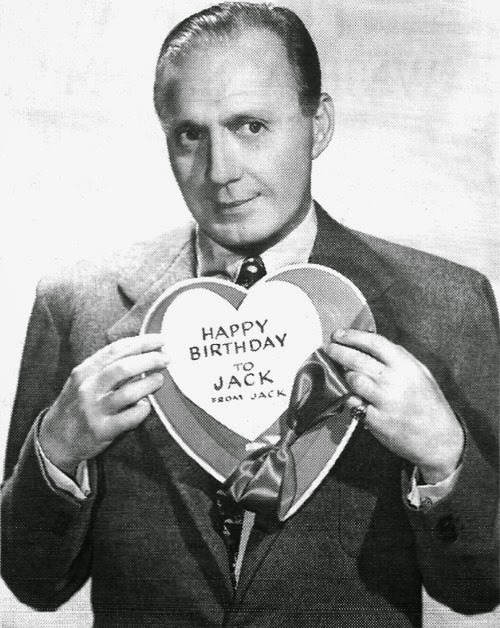
Yesterday, February the 14th, was the birthday of Jack Benny. When I was a kid, Benny's show was one of the most popular of the early tv shows. I was a fan. He had started in vaudeville, and worked his way up to spots in Broadway revues before fronting one of the first big radio shows. Benny's character on the radio and tv show was a guy named Jack Benny who was cheap, vain, egotistical, and often rather petty. (In real life Mr. Benny was quite the opposite.) I've used clips from his shows in my program several times. They are still funny and listeners often comment about them.
My radio show last night opened with a clip from one of Benny's birthday shows. There were also a few songs for Valentines Day, with the bulk of the program suspending the usual format to offer a tribute to the February 15th birthday of composer Harold Arlen. Instead of the standard moon-June kind of Valentine songs, I played a few for the lonely hearts, the broken hearts, the stood up, the also rans, those who don't want to be bothered, and the ones who don't give a damn. You know, the kind of songs that fit into dark smoky dives where your next drink gets poured without your having to ask. One of the guys who wrote a lot of those songs was Harold Arlen. I hope listeners enjoy the show.
"So," the unwary person asked, "How is Everything?"
Because he was a kind, gentle, thoughtful soul at heart, he didn't answer.
Thankfully, the period of the planet Mercury's being retrograde has ended. For now. Or so the theory goes. Both the washing machine and the dryer had broken while his clothes and bed linens were being cleaned. While typing that last sentence, he made a mistake and tried to delete the incorrect letter. It refused to budge. Then the whole page simply vanished. Being a stubborn male, he did not take the hint.
I wonder if anyone felt aggrieved by Mercury retrograde in 1944? Certainly, there wasn't any mention of the concept in the local newspaper. It was a time of some tension. That February the war was being fought in the Pacific at the Marshall Islands, along the western coast of Italy at places named Anzio and Monte Cassino, bombs were falling on London and much of Germany. The buildup of soldiers for the panned invasion of Europe was underway. Everyone waited.
By February the 12th, the 4th War Loan was ending and a new push for waste paper and kitchen fats was starting. They were products needed for the war.
February 12th, 1944 was a Saturday. That night at 11:30pm would be the weekly broadcast of the Army Air Force Band of the Training Command, under the direction of Captain Glenn Miller. The show was known as "I Sustain the Wings". My radio show (which follows) closes with a program prepared that night called "Uncle Sam Presents". I've been unable to ascertain whether it was excerpted from the regular broadcast, a rehearsal, or prepared separately. Along the way there are excerpts from the 1st Esquire Jazz awards with Louis Armstrong, Mildred Bailey, Billie Holiday, and Jack Teagarden. There are excerpts from a Feb. 1944 Downbeat with Charlie Barnet and his Orchestra - with Lester Young sitting in. And there's Bing Crosby, Judy Garland, and Frank Sinatra among others. I hope anyone who listens enjoys the show.
.jpg)


 And there was Dolly Dawn and Her Dawn Patrol. Ms. Dawn was a vocalist who joined George Hall's Taft Hotel Orchestra. Hall was a violinist who didn't play swing; he led an competent but uninspired band. Once Ms. Dawn joined up, their 6 day a week broadcasts became extremely popular. Ms. Dawn soon had a 'band within the band' set up for recordings, released as ""Dolly Dawn and Her Dawn Patrol". With record sales increasing, Hall saw his opportunity to retire from leading the band and took it, turning the band over to Ms. Dawn in a public ceremony at the Roseland Ballroom. The band gained new energy and spirit, recording under the "Dawn Patrol" moniker. It only lasted a year. The war arrived, the draft took many of the musicians, and Ms,. Dawn set out on a solo singing career. During the post war years, she too faded from public view. A 2 disc reissue of her old recordings in 1975 brought her new attention, there was a new album, and she began to perform occasionally in New York clubs.