Friday, July 4, 2014

Going fourth...

It's a rainy, cool July 4th morning here in Brattleboro. I used to really love July the 4ths. Until recent years, that is. A few years ago I had a job running a video store. It was a lot of work, but it was work that I more or less enjoyed, or to be more precise work I didn't mind all that much. I wasn't all that fond of the 12 to 15 hour days, and I recall a minor celebration when I actually got two days off one month. What I very much minded was not being fairly or properly paid, the promised raises that never arrived, etc. I quit that job on a July the 4th the owner made me work - it was going to be my first day off in two months. That impulsive action nearly destroyed my life; I was out of work for a long time. When I found work it was as a cashier in a supermarket where I was required to work on holidays, where I think I got one July the 4th off in five years. That company would schedule people to work for four hours on the fourth. I guess that had some kind of poetic ring to the Belgian corporation which owned the place. Three generations of my family had fought in the American Revolution; the day once held some meaning to me.

Thankfully, the rain this morning isn't another crazy thunderstorm. I like such storms, I like the call and response of streaks of lightning and replying thunder, the sound of the deluge of water cascading off the roof. Unfortunately, my vegetable garden is in a slightly flat depression partway down a hill, which puts it right in the path of rampaging runoff. It's a small veggie planting this year, but twice in the last week storm waters created havoc. (It has been several years since this last occurred.) Yesterday morning I spent a couple of hours fixing up the damage from the second storm. Last night there was another downpour. The rain will keep me out of the garden today, as will work on my radio show tomorrow. I must admit a certain nervousness regarding what I shall find when I get there on Sunday. I distract myself looking for July the 4th images to post from the mass media factories of America, trying not to think of the garden situation as a metaphor. 

Arlene Judge


Ava Gardner

Elizabeth Taylor

My thoughts turn to Americana. This past Monday, I became joyfully immersed in it. I talked a friend into driving two and a half hours upstate to the Shelburne Museum. It is not your everyday day museum. It was created by Electra Havemeyer Webb. Her parents, Louisine Elder and Henery Osborne Hevemeyer were wealthy. Very wealthy. Miss Electra Haveremeyer married Mr. James Watson Webb, a Vandebilt. They were very, very wealthy together.

Louisine and H.O. collected art. Louisine was touring the continent when she became friends with Mary Cassatt, who introduced her to a group of young unappreicateds who would soon be known as Impressionists. The Havemeyers became the first Americans purchasing their work. Most of the collection they acquired was left to New York City's Metropolitan Museum of Art, where their bequest became the foundation of the Impressionist wing. Some of the paintings, however, were left to Electra. They used to adorn the walls of the Havemeyer-Webb apartment at 740 Park Avenue. (If an apartment there becomes available, it is said that you must show a minimum worth of  one hundred million dollars before the cooperative will even talk to you.)

Electra and Louisine Havemeyer by Mary Cassatt


Mrs. Webb was 19 when she began to collect Americana. She loved the large summer estate the family had near Burlington, Vermont, and decided to turn part of it into a museum for her collections. That kind of space was needed. When the last surviving steamship on Lake Champlain went out of business, she bought it and had it moved to the estate. It sits near a lighthouse she purchased. She showed interesting attention to detail - the estate has many wonderful gardens; the plantings by the lighthouse are the kind of rugosa roses one finds at the sea shore near lighthouses (they have an ability to withstand salt air).


The Ticonderoga is the only surviving vertical beam sidewheel steamship.
It is 200 feet long, and weighs 892 tons.
Just past the steamship were these trees - neither my friend (a college professor) nor myself have any idea what they are - please let me know if you do:
 
Blogger has suddenly decided that I shouldn't use the "caption" function - if I try, it deletes the picture. So... just a few steps further and one finds this giant chair:
 
 
(And, in case you are wondering, yes, that is your correspondent taking a break and sitting down.)
 
Mrs. Webb saved one local old Shelburne building from demolition, moved it to the estate, and reused it for her collection of the contents of a circa 1840's General Store, Post Office, Barber Shop and Apothecary. (There is a similar era dentist office on the second floor.) She occasionally bought the collections of others. Next to the barber shop is a room with over 300 straight razors, the collection of a wealthy lawyer.  I didn't take any pictures of the store (I was often too overwhelmed to think of it) but I did take a few in the apothecary.


When I commented on the placement of a couple of objects amusingly displayed in the store, the docent noted that they were "right where Mrs. Webb put them".
 
She also saved a local meeting house and had it moved to the grounds. It houses a collection of Vermont music.
 
She had a small pond installed next to the meeting house:
 
Elsewhere on the property are an old train station (with a 10 wheel steam locomotive), a carousel, a sawmill, a covered bridge, collections of carriages, Conestoga wagons, stagecoaches, hand carved circus miniatures, a jailhouse, textiles (a huge quilt collection), weathervanes, hunting decoys, an  1840's smokehouse, a Shaker shed, a round barn, a worker's stone cottage, and much, much more.

On the property, as a tribute to Mrs. Webb, the family built a reproduction of a fairly un-Vermont Greek Revival Vermont building she admired. In it they put five intact rooms from the Park Avenue digs. The rooms are stunning. The library, for instance, utilized dark wood moldings and black leather wallpaper. (I think I swooned at that point.) Throughout the rooms are the paintings Mrs. Webb's parents left her. Two Rembrandts, Corot, I think there was an El Greco, etc. In a basement room are bronze sculptures by many artists including Degas and Frederick Remington. A number of painting are not in the apartments at present - and therein lies the reason for this trip.

A new building on the estate currently has a temporary museum styled exhibition of the Impressionist holdings, punningly titled "In a New Light". Five or six Monets, several Manets, Degas, Corot, Cassatt. Even the doorway to the exhibit held promise (the Monet which was the source for this image in on display):


The first thing visible upon entering was Monet's "Le Pont, Amersterdam". Just to its left and several feet back was a large photograph of the actual scene. It was very interesting to note that Monet moved buildings and objects a bit to paint what he saw.


One Monet in particular haunts me, not quite to the point of obsession. The reproduction of it does not catch the colors at all. What appears here as a sort of reddish haze was actually sort of, well, not quite chartreuse, not yellow, but definitely early morning light through fog. I think the problem may be that this "Church at Vernon through fog" (near his home at Giverny) is a view Monet painted many times. I wonder if the online reproductions of the painting owned by Mrs. Webb is the same as the one on exhibit.


Blogger and my photo program are both acting up, which may be a last gasp of Mercury retrograde, or the electronics' method of telling me this post is too long, or contains too many graphics, so to rush to a finish...

The Cassatt at the beginning of this essay is also on display, along with several other pieces which I recognized from books, and a few I'd never seen before. I must post this one more, simply because its colors were so stunning, a Degas (what was it with Degas and ballerinas anyway? Maybe he just wanted to try on a tutu?) :


The exhibit was clever, stunningly beautiful, and the works are still in my mind's eye four days later. There was so much to see...

I must go back there soon.


Thursday, July 3, 2014

Divertisement


A Modest Proposal for the Preservation of Individual Rights and Liberties.
 
In Brattleboro- July 3rd, 2014

When, in the course of legal events it becomes evident that the separate and equal rights which the Laws of Nature and Nature’s God entitles us have become diluted, a decent respect for the opinions of others requires some explanation of the course of action being proposed.

Whereas the business community incorporated enjoys benefits of low to no taxes, taxpayer funded operating and research subsidies, the ability of the Officers of the Corporation to not be held personally responsible for the debts of the corporation engendered by them, legal protection of name and accounts against piracy, legal ability to financially influence elections and lawmaking beyond what is seemly, ability to discriminate against others on religious grounds, and sundry other benefits which are not available to the common taxpayer, a course of corrective action in favor of the individual is required. Corporations enjoy such rights, and corporations are considered to have the rights of individuals. Therefore, I humbly propose that each and every one of us becomes our own closely held individual Corporation.

In the state of Vermont, a “B corporation” (for Benefit Corporation) status is available. Decisions affecting the operation of such corporation take into account social and environmental missions, and a public benefit (i.e a percentage of profits donated to a specific cause) may be declared. Such a corporation may name specific benefit purposes, i.e. influencing educational standards that affect the children of our corporate families, by advocating for the teaching of fact based science, etc.

It might be best, however, to incorporate in some offshore country which exists basically for the evasion of taxes. As the corporation will advocate for wealthy and large corporate entities to pay a more equitable share of their income in taxes, this may seem ill advised. But in an era in which a company can successfully argue for a faith based exemption from providing health care which includes birth control, while that same company has investments in the manufacture of contraceptives, the concept of hypocrisy has obviously lost any meaning or sense of shame. Incorporating in another country could, therefore, be presented as a public display of our seriousness of purpose.

As the process of incorporation will require some small investment, as well as a Board of Directors of the corporation, I propose an even exchange – help me afford the cost and become a member of my board, and I will do the same for you.

As one of the first orders of business would be in the arena of public education, namely the encouraging of others to invest in individual corporations, we would, of course, offer advice and services to that end for a small fee. I would therefore suggest the adoption of a slogan on the order of “Control your fate – incorporate!”

Those interested in being on the Board of my corporate entity should contact me privately.

Thank You.

Wednesday, July 2, 2014

getting there

My garden is at Solar Hill, which is about a 40 minute walk from where I live. It's an enjoyable enough walk, with a number of interesting buildings and front yard gardens along the way. I like the effects of early morning light.

Once I get about half a block down the street, I usually cross at about this point and cut through the town common. Currently, the white clover is in bloom.
There are momentary distractions along the way...
 
The wood on the side of the dirt road up Solar Hill.


I generally go there very early in the morning these days as I am now finding it quite uncomfortable to work in the sun after about 11am. The changes in just one day can be surprising. The berry like slightly out of focus red buds in yesterday's picture look like this today:


And the as yet to open gloriosa daisy from yesterday came into better focus....
 
The cemetery rose that hides in the day lily foliage was blooming too. I found its parent in a friend's family cemetery many years ago; it was in the mid 1800's section of the plots.  It is heavily scented, by the way.
 
Also new this morning:
 

On the way home, about two blocks from where I live, there is a legal office which painted its side wall this spring. I've already made this pic my desktop:


Tuesday, July 1, 2014

In the morning garden July 1st, 2014

Okay, it's like this. Somehow, even though I have more time to do things since I retired, I often feel like I have no time, meaning time available. I've been pushing off getting back to this blog as I am the type of person who would like to have things just so, and so on, and so forth, etcetera ad infinitum. And I should tell you first about Solar Hill, all properly illustrated with my own photographs, of course. I have a garden there within a much larger garden; and I should tell you about the gardens and some of the idiosyncrasies of the place, like the silent walkers. I do and don't want to note my frustrations trying to use the cheap point and click digital camera I purchased last year which I am still trying to figure out how to use, or to be more correct how to make do what I want it to instead of what it wants to do because it's a cheap point and click digital camera.

So, if I don't start posting a few of my pictures I'll never get this story started. It does take awhile to tell. That's the way gardens are. 

Early on the morning on July 1st, 2014...


Sunday, April 27, 2014

The green light at the end of the dock...

Last week one of those anniversaries that media outlets love to note occurred. Network tv stations, as well as various internet outlets, showed about 30 seconds worth of fuzzy film footage before moving on to something else. But that little bit of 'soft news' gave me pause. The warm glow of nostalgia, as fuzzy as the images, began to flow. Yes, I had been there. I had seen. I had experienced. I had lived.

You see, on April the 23rd, it was 50 years to the day since the New York World's Fair of 1964 - 1965 opened. A couple of times, it was referred to as "The World of Tomorrow". That phrase was, we were told, the slogan of the fair and was solemnly intoned while a picture of the Unisphere was shown. Except it wasn't. That  was the slogan of the 1939 - 1940 fair, held at the same location. In fact, the symbols of that earlier fair, the Trylon and Perisphere, were in the same exact spot where the Unisphere was built. The Unisphere was the largest model of our planet ever constructed, made out of the finest U.S. Steel. It was at the center point of the fair in a reflecting pool, surrounded by fountain jets of water which reached upward to the sky mirroring our hopes and ambitions for "Peace Through Understanding",  the fair's actual motto.

I knew all of this for the simple reason that I was 13 years old and desperate to escape (even for a few paltry hours) from my ordinary little home town in the southern part of New Jersey. This wasn't just a World's Fair, it was a New York World's Fair. Baghdad on the subway. Visions of delightful (but unspecified) decadence floated before my mental eyes like those conjured by the Devil to tempt the Christ during His sojourn in the desert. I knew this for a fact; I had seen the movie.

I managed to get to the fair twice. If memory isn't playing a trick or two to embroider the sense of stultification I was experiencing in my hometown, there was an excursion with the Methodist Youth Fellowship, and a trip with the Boy Scouts. I was that desperate to go. It is a wonder I remember that part at all. I remember the long bus journey there. I remember walking down a seemingly endless boardwalk, through an awning of stylized wings that seemed poised to take off . Without warning, rising from a sea of color, it loomed in front of me, a vision, a dream, a temptation - the Unisphere. I had arrived.


There had been months spent in expectant, torturous, exquisite waiting. My father allowed that he hated New York and would get nowhere near the place, but that as a teenager he had gone to the 1939 fair and loved it. I had already found the jig saw puzzle he had purchased as a souvenir. It was a map of the fair, and was missing pieces. I had still put it together, and fallen in love with the Trylon and Perisphere symbols. After a bit of outright begging, he allowed me to use his 8mm Bell and Howell camera to take movies while I was there. The camera was a little finicky as to settings in strong daylight, so he also allowed me to use his light meter. Weeks later I would discover that the light meter was no longer working properly and the footage of the fair was horribly overexposed. For the 1965 edition, he allowed the use of his new super 8 movie camera, after the requisite repeated begging of course. One of these days I must get those put into digital format. I didn't take still pictures, but I did take slides  - with my new Instamatic camera, purchased at Mr. Duper's Hobby Shop on my town's Main Street. The Hobby Shop was next to the storefront that was the Greek's diner where I used to purchase my cherry cokes after the soda fountain at the Rexall was removed. If the place had a real name, I never knew it. Everyone called it "the Greek's", a bow to the ethnicity of its proprietor. It was on such an excursion that I'd noticed the arrival of the new Kodak camera on display in the Hobby Shop window, and began to save my pennies.


When the Kodak pavilion was included in the 50th anniversary news reports, only one mentioned that it displayed the largest color photos made up to that date. No one mentioned that the rest of the building's roof was a futuristic moonscape - with spots which had placards which noted them as being perfect for taking pictures of the fair. Which brings up one other little matter, best illustrated with this commercial:


The reason I wanted to post that is very simple - it is in black and white. So was television then. In fact, it was at the fair's RCA pavilion that color tv was first demonstrated for eager dreamy eyed buyers. (Movies had been black and white, too, with color saved for big budget spectaculars and musicals.) Quite a bit of what has turned up documenting the fair is in black and white, which does it a great disservice. It was the early 60's, the world had become color, and the circus had come to town.

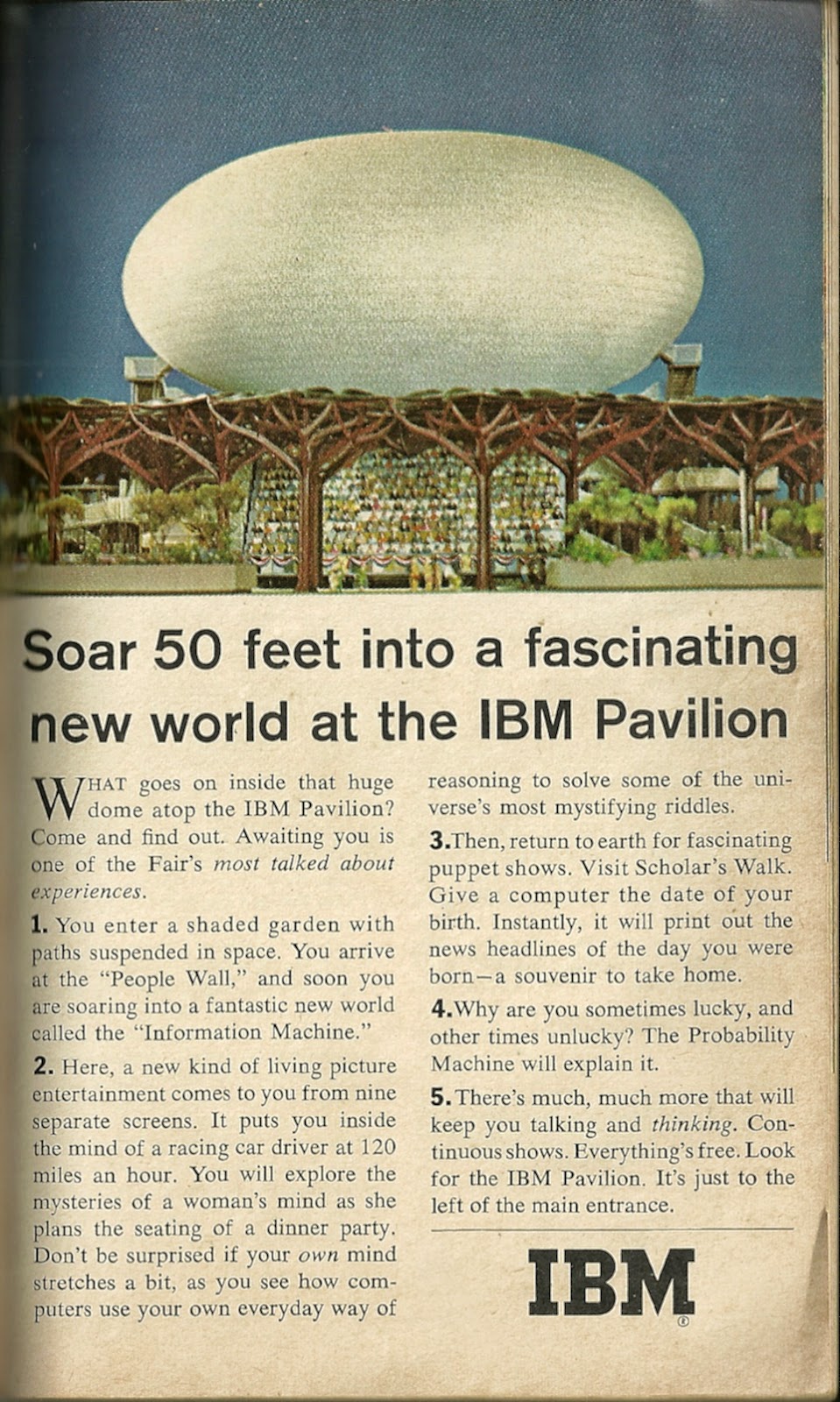
One of the exhibits which fascinated me the most was the IBM pavilion. Floating above what seemed like a sea of metal treetops was a giant egg. I've never been sure what that was supposed to represent, or what meaning was attached to it. Perhaps it was an expression of the Dadaist sensibility inherent in the newly emerging corporate environment. Here's the advertisement for it from my 1964 guidebook to the fair. Notice the color wall in the center - it was row upon row of seats, steeply raked. The wait to sit there seemed like it would take you clear into 1965. After every seat was taken, the wall was raised via hydraulic lifts into the egg where a movie was exhibited on a series of giant screens. It was wonderful.

 
I no longer remember anything about the movie, just the experience of it. After the wall of people was lowered, the exit took one past something almost unbelievable. It was a machine that ingested cards. One was invited to write a date on a card, and the machine would not only read the handwriting, it would tell you what happened on that date, as per the headlines of the New York Times. I wrote September 7th, 1950. I was born on the 6th, The Times was a morning paper - if it worked, the headline would tell me what had happened on the day I was born. This was no mere sideshow gimmick, this was the future. The device was called a "computer".


Not quite 20 years and a lifetime later would come a particular Christmas. A few years before, I had rebelled against the standard family gift giving of useful socks and ties, to give things that were fun and hopefully enjoyable. That year, my father and stepmother finally gave in and asked me what I would like that was something fun rather than a necessary item. I told them they couldn't afford what I wanted. After all, it cost over a hundred dollars! Amused, they asked what had so caught my imagination. I told them. It was a Commodore 64c computer. The "c" after the 64 meant that it had a display that was in color. After a couple of weeks they called me back and proposed we split the cost - they would pay half, but there would be no other gift that year. I agreed. I've been at it ever since.
 
There are so many memories of the fair knocking around in my brain, impressions really. But as soon as I see a picture, I can usually tell you what the object was, what  pavilion housed it. After the internet got started, I would perform occasional searches for graphics of the fair. I began collecting the few things that turned up of the 1939 version as well as the 64. There was never much to be found. Over the last few years, a number of pictures and You Tube videos have happily appeared. I've long intended to start posting the ones I've collected, and hopefully I'll now follow through.
 
It was at that fair that I saw visions of the future. It was at that fair that Walt Disney introduced "audio animatronics" (one of Abraham Lincoln stood up and gave a speech!)(and I still have the recording of it), it was at that fair that Ford introduced the Mustang, it was at that fair that I marveled at the exquisite curves and lines of Michelangelo's Pieta and discovered a desire to see art in person rather than in picture books, it was at that fair that I was given a copy of the Book of Mormon, it was at that fair that the world learned the joys of the Belgian waffle, topped with cream and strawberries, it was at that fair that a new type of telephone was on display - you could see the person you were talking to on a tiny screen. Nah, it'd never catch on.  
 
In 1968 I attended college in northern New Jersey, an hour's train ride from New York City. My first excursion was to the Museum of Modern Art to see a silent movie. Train trips are great for reading and pondering. On the trip back from that first day in the city, I finished reading "The Great Gatsby". I closed the cover with a sigh and a great deal of satisfaction. I was only able to afford one year of college. I didn't get the scholarship I needed to continue. I went to Ocean City NJ for the summer, and stayed as I began working to support myself. In the fall of 1972, I moved to Manhattan. It had become the place of my dreams, the center of learning, museums, culture, theatre, music,  movies, bookstores, it was where the world of tomorrow was being born. I would live there on a voyage of discovery for 15 years. Somewhere around 1975 or so, I headed out on the subway to a special stop, a park that had once been an ash heap which had featured prominently in "The Great Gatsby". It was all a bit derelict and sad. Here and there patches of grass peeked through barren soil.  In the center of the park, in an empty fountain, stood a giant globe made out of steel.
 
 
I drifted away, and never went back.
 
Years later I moved on, "a boat against the current, borne back ceaselessly into the past”.


Monday, March 24, 2014

Taking time...

You must have been warned against letting the golden hours slip by;
but some of them are golden only because we let them slip by.

                                                    James M. Barrie

Was it Slaughterhouse Five in which the hero became "unstuck in time"? Actually, it's odd that I asked that question. I know darn well that the phrase originated with that book. Perhaps my subconscious wants to formally recognize my disengagement with the world at large in a self-effacing manner. Perhaps I have an unexpressed desire to note the influence of Kurt Vonnegut (author of the aforementioned tome) upon my worldview. There is, however, a slight difference between being unstuck in time and being lost in time. I'd like to think I have permitted myself both experiences. While the physical world I inhabit basically expresses itself in a linear fashion, it seems that my mental process and focus has become fond of what is referred to as Attention Deficit Disorder. That concept is presented as a malady, although whether or not it is should, perhaps, be questioned. To be honest, most things in life don't seem to be worth the attention we give them. No matter. (Okay, brain, was that some sort of bad existential pun?) What I'm trying to get at regards my latest interaction with the concept of time. I've lost it. Meaning my ability to control my use of it. It began, as it often does, with Daylight Savings.

 
A little over two weeks ago, entire masses of people messed with the perceived linearity of time and moved it ahead by an hour. As usual, this made countless people cranky and out of sorts. It must have been even worse during the mid 1940's when the United States experienced "War Time". Where I live, for instance, instead of "Eastern Standard Time", or "Eastern Daylight Time", one would have noted "Eastern War Time".  "War Time" was an all year round Daylight Savings Time. Some countries had "Double War Time".


Now, since "Daylight Savings Time" starts with moving one's clocks ahead by one hour, those under its sway lose an hour of time. How, may I ask, is that a 'savings'? Someone, or something, has grabbed an hour of our time and pocketed it. A little research provided the information that Daylight Savings Time was started in 1918, allegedly to save electricity during World War One. Of course, not much of the country was electrified at that point (I must assume the intended savings was in a source of fuel for heat), and WWI ended in 1918. The United States Congress repealed the enabling act in 1919 - over a Presidential veto. "Savings" time was only made possible when time was 'standardized' in 1883 at the behest of the railroads. I should have known this was another idea foisted upon us by the corporations. Standard time became permanent law in 1918 (via the same act that brought the soon to be repealed daylight savings). In 1942, the US enacted "War Time", which ended shortly after the official surrender of Japan in 1945. After that, it was up to each state to decide whether or not to play with their clocks (which, when put that way, sounds vaguely dirty). There was another Uniform Time Act in 1966, further tinkering by the Reagan administration, and so on.


(Whomever did these two graphics doesn't seem to realize that
turning back the clock would be necessary to make it standard time - unless
this was created to stop WWII "war time" and referred to going back to WWI time...)
I've just managed to spend an hour and a half researching and writing, editing, attempting corrections to syntax and tense (which made me tense) and etcetera. What I had expected to be a pleasurable hour pontificating about something rather meaningless, discussing my adventures of the last few weeks, posting a few photographs and/or amusing graphics, changed, morphed, and lost focus as I lost control of my time and my personal expectation of how I would spend that time.


I haven't even gotten to the odd co-incidences . For instance, John C. Reilly showed up three times in one week - starting with a chanced upon bad movie called "Cirque du Freak: The Vampire's Assistant" on a cable tv channel. Somewhat intrigued by a fun title sequence, I recorded it as I didn't wish to spend the time to watch it in what was, at the time, the broadcast present. I, umm, time-shifted it. Then it turned out that Geo's Trainride Of The Enigmas blog had recently included a clip of Mr. Reilly performing the "Mr. Cellophane" number from the movie version of "Chicago" (which I was fortunate to see in its initial incarnation on Broadway - which was to be part of this dissertation). Another of the several movies waiting for my viewing pleasure via the digital recording device, and which has popped up in several unexpected ways over the last few weeks, is the 1960 movie version of "The Time Machine".


Oh, Dear. I've just glanced at the clock again and realized I must go. My meditation upon whether I am a Morlock, a meal, or a talking ring and what all of that has to do with DeLoreans and  net neutrality will have to wait...