Wednesday, July 2, 2014

getting there

My garden is at Solar Hill, which is about a 40 minute walk from where I live. It's an enjoyable enough walk, with a number of interesting buildings and front yard gardens along the way. I like the effects of early morning light.

Once I get about half a block down the street, I usually cross at about this point and cut through the town common. Currently, the white clover is in bloom.
There are momentary distractions along the way...
 
The wood on the side of the dirt road up Solar Hill.


I generally go there very early in the morning these days as I am now finding it quite uncomfortable to work in the sun after about 11am. The changes in just one day can be surprising. The berry like slightly out of focus red buds in yesterday's picture look like this today:


And the as yet to open gloriosa daisy from yesterday came into better focus....
 
The cemetery rose that hides in the day lily foliage was blooming too. I found its parent in a friend's family cemetery many years ago; it was in the mid 1800's section of the plots.  It is heavily scented, by the way.
 
Also new this morning:
 

On the way home, about two blocks from where I live, there is a legal office which painted its side wall this spring. I've already made this pic my desktop:


Tuesday, July 1, 2014

In the morning garden July 1st, 2014

Okay, it's like this. Somehow, even though I have more time to do things since I retired, I often feel like I have no time, meaning time available. I've been pushing off getting back to this blog as I am the type of person who would like to have things just so, and so on, and so forth, etcetera ad infinitum. And I should tell you first about Solar Hill, all properly illustrated with my own photographs, of course. I have a garden there within a much larger garden; and I should tell you about the gardens and some of the idiosyncrasies of the place, like the silent walkers. I do and don't want to note my frustrations trying to use the cheap point and click digital camera I purchased last year which I am still trying to figure out how to use, or to be more correct how to make do what I want it to instead of what it wants to do because it's a cheap point and click digital camera.

So, if I don't start posting a few of my pictures I'll never get this story started. It does take awhile to tell. That's the way gardens are. 

Early on the morning on July 1st, 2014...


Sunday, April 27, 2014

The green light at the end of the dock...

Last week one of those anniversaries that media outlets love to note occurred. Network tv stations, as well as various internet outlets, showed about 30 seconds worth of fuzzy film footage before moving on to something else. But that little bit of 'soft news' gave me pause. The warm glow of nostalgia, as fuzzy as the images, began to flow. Yes, I had been there. I had seen. I had experienced. I had lived.

You see, on April the 23rd, it was 50 years to the day since the New York World's Fair of 1964 - 1965 opened. A couple of times, it was referred to as "The World of Tomorrow". That phrase was, we were told, the slogan of the fair and was solemnly intoned while a picture of the Unisphere was shown. Except it wasn't. That  was the slogan of the 1939 - 1940 fair, held at the same location. In fact, the symbols of that earlier fair, the Trylon and Perisphere, were in the same exact spot where the Unisphere was built. The Unisphere was the largest model of our planet ever constructed, made out of the finest U.S. Steel. It was at the center point of the fair in a reflecting pool, surrounded by fountain jets of water which reached upward to the sky mirroring our hopes and ambitions for "Peace Through Understanding",  the fair's actual motto.

I knew all of this for the simple reason that I was 13 years old and desperate to escape (even for a few paltry hours) from my ordinary little home town in the southern part of New Jersey. This wasn't just a World's Fair, it was a New York World's Fair. Baghdad on the subway. Visions of delightful (but unspecified) decadence floated before my mental eyes like those conjured by the Devil to tempt the Christ during His sojourn in the desert. I knew this for a fact; I had seen the movie.

I managed to get to the fair twice. If memory isn't playing a trick or two to embroider the sense of stultification I was experiencing in my hometown, there was an excursion with the Methodist Youth Fellowship, and a trip with the Boy Scouts. I was that desperate to go. It is a wonder I remember that part at all. I remember the long bus journey there. I remember walking down a seemingly endless boardwalk, through an awning of stylized wings that seemed poised to take off . Without warning, rising from a sea of color, it loomed in front of me, a vision, a dream, a temptation - the Unisphere. I had arrived.


There had been months spent in expectant, torturous, exquisite waiting. My father allowed that he hated New York and would get nowhere near the place, but that as a teenager he had gone to the 1939 fair and loved it. I had already found the jig saw puzzle he had purchased as a souvenir. It was a map of the fair, and was missing pieces. I had still put it together, and fallen in love with the Trylon and Perisphere symbols. After a bit of outright begging, he allowed me to use his 8mm Bell and Howell camera to take movies while I was there. The camera was a little finicky as to settings in strong daylight, so he also allowed me to use his light meter. Weeks later I would discover that the light meter was no longer working properly and the footage of the fair was horribly overexposed. For the 1965 edition, he allowed the use of his new super 8 movie camera, after the requisite repeated begging of course. One of these days I must get those put into digital format. I didn't take still pictures, but I did take slides  - with my new Instamatic camera, purchased at Mr. Duper's Hobby Shop on my town's Main Street. The Hobby Shop was next to the storefront that was the Greek's diner where I used to purchase my cherry cokes after the soda fountain at the Rexall was removed. If the place had a real name, I never knew it. Everyone called it "the Greek's", a bow to the ethnicity of its proprietor. It was on such an excursion that I'd noticed the arrival of the new Kodak camera on display in the Hobby Shop window, and began to save my pennies.


When the Kodak pavilion was included in the 50th anniversary news reports, only one mentioned that it displayed the largest color photos made up to that date. No one mentioned that the rest of the building's roof was a futuristic moonscape - with spots which had placards which noted them as being perfect for taking pictures of the fair. Which brings up one other little matter, best illustrated with this commercial:


The reason I wanted to post that is very simple - it is in black and white. So was television then. In fact, it was at the fair's RCA pavilion that color tv was first demonstrated for eager dreamy eyed buyers. (Movies had been black and white, too, with color saved for big budget spectaculars and musicals.) Quite a bit of what has turned up documenting the fair is in black and white, which does it a great disservice. It was the early 60's, the world had become color, and the circus had come to town.

One of the exhibits which fascinated me the most was the IBM pavilion. Floating above what seemed like a sea of metal treetops was a giant egg. I've never been sure what that was supposed to represent, or what meaning was attached to it. Perhaps it was an expression of the Dadaist sensibility inherent in the newly emerging corporate environment. Here's the advertisement for it from my 1964 guidebook to the fair. Notice the color wall in the center - it was row upon row of seats, steeply raked. The wait to sit there seemed like it would take you clear into 1965. After every seat was taken, the wall was raised via hydraulic lifts into the egg where a movie was exhibited on a series of giant screens. It was wonderful.
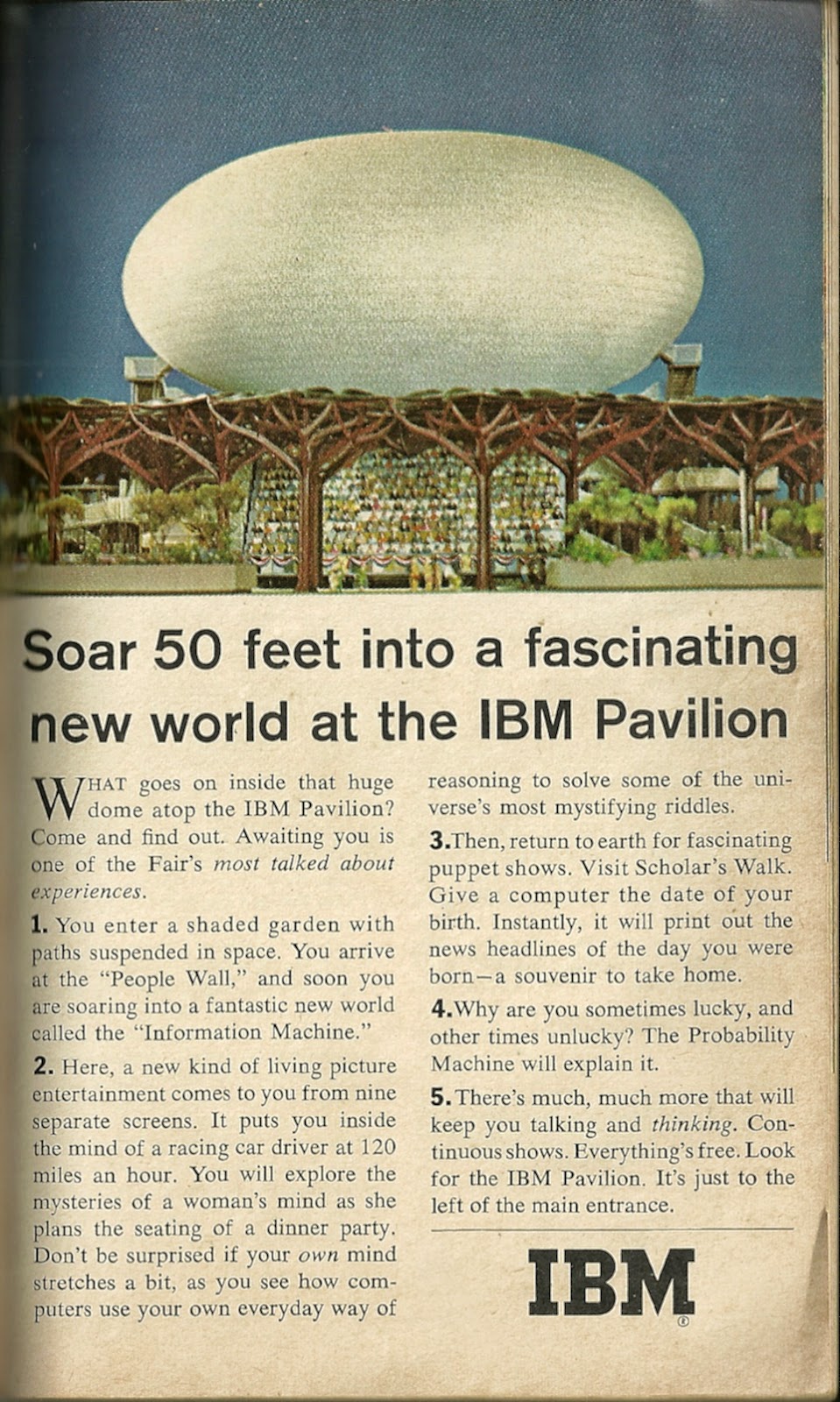
 
I no longer remember anything about the movie, just the experience of it. After the wall of people was lowered, the exit took one past something almost unbelievable. It was a machine that ingested cards. One was invited to write a date on a card, and the machine would not only read the handwriting, it would tell you what happened on that date, as per the headlines of the New York Times. I wrote September 7th, 1950. I was born on the 6th, The Times was a morning paper - if it worked, the headline would tell me what had happened on the day I was born. This was no mere sideshow gimmick, this was the future. The device was called a "computer".


Not quite 20 years and a lifetime later would come a particular Christmas. A few years before, I had rebelled against the standard family gift giving of useful socks and ties, to give things that were fun and hopefully enjoyable. That year, my father and stepmother finally gave in and asked me what I would like that was something fun rather than a necessary item. I told them they couldn't afford what I wanted. After all, it cost over a hundred dollars! Amused, they asked what had so caught my imagination. I told them. It was a Commodore 64c computer. The "c" after the 64 meant that it had a display that was in color. After a couple of weeks they called me back and proposed we split the cost - they would pay half, but there would be no other gift that year. I agreed. I've been at it ever since.
 
There are so many memories of the fair knocking around in my brain, impressions really. But as soon as I see a picture, I can usually tell you what the object was, what  pavilion housed it. After the internet got started, I would perform occasional searches for graphics of the fair. I began collecting the few things that turned up of the 1939 version as well as the 64. There was never much to be found. Over the last few years, a number of pictures and You Tube videos have happily appeared. I've long intended to start posting the ones I've collected, and hopefully I'll now follow through.
 
It was at that fair that I saw visions of the future. It was at that fair that Walt Disney introduced "audio animatronics" (one of Abraham Lincoln stood up and gave a speech!)(and I still have the recording of it), it was at that fair that Ford introduced the Mustang, it was at that fair that I marveled at the exquisite curves and lines of Michelangelo's Pieta and discovered a desire to see art in person rather than in picture books, it was at that fair that I was given a copy of the Book of Mormon, it was at that fair that the world learned the joys of the Belgian waffle, topped with cream and strawberries, it was at that fair that a new type of telephone was on display - you could see the person you were talking to on a tiny screen. Nah, it'd never catch on.  
 
In 1968 I attended college in northern New Jersey, an hour's train ride from New York City. My first excursion was to the Museum of Modern Art to see a silent movie. Train trips are great for reading and pondering. On the trip back from that first day in the city, I finished reading "The Great Gatsby". I closed the cover with a sigh and a great deal of satisfaction. I was only able to afford one year of college. I didn't get the scholarship I needed to continue. I went to Ocean City NJ for the summer, and stayed as I began working to support myself. In the fall of 1972, I moved to Manhattan. It had become the place of my dreams, the center of learning, museums, culture, theatre, music,  movies, bookstores, it was where the world of tomorrow was being born. I would live there on a voyage of discovery for 15 years. Somewhere around 1975 or so, I headed out on the subway to a special stop, a park that had once been an ash heap which had featured prominently in "The Great Gatsby". It was all a bit derelict and sad. Here and there patches of grass peeked through barren soil.  In the center of the park, in an empty fountain, stood a giant globe made out of steel.
 
 
I drifted away, and never went back.
 
Years later I moved on, "a boat against the current, borne back ceaselessly into the past”.


Monday, March 24, 2014

Taking time...

You must have been warned against letting the golden hours slip by;
but some of them are golden only because we let them slip by.

                                                    James M. Barrie

Was it Slaughterhouse Five in which the hero became "unstuck in time"? Actually, it's odd that I asked that question. I know darn well that the phrase originated with that book. Perhaps my subconscious wants to formally recognize my disengagement with the world at large in a self-effacing manner. Perhaps I have an unexpressed desire to note the influence of Kurt Vonnegut (author of the aforementioned tome) upon my worldview. There is, however, a slight difference between being unstuck in time and being lost in time. I'd like to think I have permitted myself both experiences. While the physical world I inhabit basically expresses itself in a linear fashion, it seems that my mental process and focus has become fond of what is referred to as Attention Deficit Disorder. That concept is presented as a malady, although whether or not it is should, perhaps, be questioned. To be honest, most things in life don't seem to be worth the attention we give them. No matter. (Okay, brain, was that some sort of bad existential pun?) What I'm trying to get at regards my latest interaction with the concept of time. I've lost it. Meaning my ability to control my use of it. It began, as it often does, with Daylight Savings.

 
A little over two weeks ago, entire masses of people messed with the perceived linearity of time and moved it ahead by an hour. As usual, this made countless people cranky and out of sorts. It must have been even worse during the mid 1940's when the United States experienced "War Time". Where I live, for instance, instead of "Eastern Standard Time", or "Eastern Daylight Time", one would have noted "Eastern War Time".  "War Time" was an all year round Daylight Savings Time. Some countries had "Double War Time".


Now, since "Daylight Savings Time" starts with moving one's clocks ahead by one hour, those under its sway lose an hour of time. How, may I ask, is that a 'savings'? Someone, or something, has grabbed an hour of our time and pocketed it. A little research provided the information that Daylight Savings Time was started in 1918, allegedly to save electricity during World War One. Of course, not much of the country was electrified at that point (I must assume the intended savings was in a source of fuel for heat), and WWI ended in 1918. The United States Congress repealed the enabling act in 1919 - over a Presidential veto. "Savings" time was only made possible when time was 'standardized' in 1883 at the behest of the railroads. I should have known this was another idea foisted upon us by the corporations. Standard time became permanent law in 1918 (via the same act that brought the soon to be repealed daylight savings). In 1942, the US enacted "War Time", which ended shortly after the official surrender of Japan in 1945. After that, it was up to each state to decide whether or not to play with their clocks (which, when put that way, sounds vaguely dirty). There was another Uniform Time Act in 1966, further tinkering by the Reagan administration, and so on.


(Whomever did these two graphics doesn't seem to realize that
turning back the clock would be necessary to make it standard time - unless
this was created to stop WWII "war time" and referred to going back to WWI time...)
I've just managed to spend an hour and a half researching and writing, editing, attempting corrections to syntax and tense (which made me tense) and etcetera. What I had expected to be a pleasurable hour pontificating about something rather meaningless, discussing my adventures of the last few weeks, posting a few photographs and/or amusing graphics, changed, morphed, and lost focus as I lost control of my time and my personal expectation of how I would spend that time.


I haven't even gotten to the odd co-incidences . For instance, John C. Reilly showed up three times in one week - starting with a chanced upon bad movie called "Cirque du Freak: The Vampire's Assistant" on a cable tv channel. Somewhat intrigued by a fun title sequence, I recorded it as I didn't wish to spend the time to watch it in what was, at the time, the broadcast present. I, umm, time-shifted it. Then it turned out that Geo's Trainride Of The Enigmas blog had recently included a clip of Mr. Reilly performing the "Mr. Cellophane" number from the movie version of "Chicago" (which I was fortunate to see in its initial incarnation on Broadway - which was to be part of this dissertation). Another of the several movies waiting for my viewing pleasure via the digital recording device, and which has popped up in several unexpected ways over the last few weeks, is the 1960 movie version of "The Time Machine".


Oh, Dear. I've just glanced at the clock again and realized I must go. My meditation upon whether I am a Morlock, a meal, or a talking ring and what all of that has to do with DeLoreans and  net neutrality will have to wait...


Thursday, February 27, 2014

It worked! (So far)

Since yesterday morning, I haven't had a single spam message here on the blog. I didn't want to put any restrictions on anyone's ability to post a response to my ramblings, thinking such restrictions to be a tad unfair, forcing one to be a member of the club so to speak. In a better world.... but I might as well believe in the realm of Prester John where growth hormone free milk and honey from flowers whose plants have never seen a pesticide or genetic modification flow with equanimity to all.

Without looking back through the comments, I do believe that both Delores and Geo recommended this move. I should have taken their advice years ago. What can I say; aging, stubborn male at work.

There have been so many odd little things capturing my attention lately. Many of them have been of archeological origin. The mounds of Ireland became a huge fascination last month. I'd often wondered about them, having first become aware of the concept as a teenager reading Tolkien. In January, my online perambulations let to a website about the 'passage' mound at Newgrange. It's older than Stonehenge. Older than the pyramids at Giza. At the entrance to the mound, and at various points inside, spiral carvings are present. Their meaning is unknown. To me, they look like a map of the area's mounds, waiting for a present day Schliemann to follow their clues to some ancient secret.

Spirals at the entrance to the Newgrange mound, photographed around 1905.

The inner chamber at Newgrange is filled with sunlight on the winter solstice. There is a lottery every year to see this effect. I'd love to go, adding it to my list of places to be experienced should I ever acquire funds to travel. Stonehenge is on the list, as are the pyramids and so on and so forth. Over the last couple of years, I've realized that I have long been fascinated by monumental architecture. Giant tombs of antiquity and ancient ruins don't limit this interest. For instance, I would love to see the Colosso dell'Appennino, a sculpture by Giambologna erected in 1580. It was part of a large estate in Tuscany which was abandoned and mostly demolished in 1820. The estate changed hands a few times, became an English style garden, etc. It is currently owned by the province of Florence and is open for visitors from May to September.


The Colosso dell'Appennino

What is it about such structures that fascinates me? The idea of sailing on a body of water and suddenly stumbling upon something like this immediately comes to mind. Perhaps it is one of the few areas of life left in which one might find a little bit of mystery or romance. Imagine trekking through a jungle and chancing upon the remnants of an earlier civilization, overgrown and forgotten: 


It's not that I have a secret wish to be a latter day Indiana Jones. Perhaps it's a desire for wonder, a curiosity about whomever left something like this behind, how and why it came to be built. Perhaps I just have a need to see things like this for myself because I no longer trust the internet - there are too many people with Photoshop skills and time on their hands to create images that fascinate. I have no idea if the following Easter Island picture is real, but I have found variations of it with other people in the picture, so I suspect that it is.
 
 
Sometimes it is the part we can't see that holds the real fascination. In early photographs of the Sphinx, the arms are not visible. They had to dig out around it to expose them. I wonder if they've dug out around the pyramids?

A couple of years ago, I started a specifically uncategorized file of pictures which I find interesting. It's main purpose is to provide a slideshow screensaver which kicks in after the computer is idle for 5 or 10 minutes. There are many pictures similar to the above in the folder. Others are of movie theatres, or the long vanished Pennsylvania Station, advertising from years gone by, my own attempts at photography, movie posters, classic automobiles, all the sundry items which have caught my interest. I have often found myself sitting here staring at the images, lost in wandering thoughts, unable to interrupt the show to return to whatever project it was on which I was working. Quite often, reality would intrude with the jarring sound that plays when I get email. I used to have a nice, quiet sound that I liked selected for this purpose, but a problem with Norton led me to let a woman in India resolve it by giving her control of my computer for 20 minutes. I watched and was able to stop what she was doing if I felt it was needed. Somehow, the process changed a few settings and I've never been able to get things completely back to the way I had them. Perhaps change is good, I reasoned, and gave up the fight. (For awhile, anyway. ) In the meantime, the sound which wakes me from such reveries is not tolling for me at present, the blog is not reporting a stream of spam. But I have too much to do to let myself wander around monuments, or wonder why they fascinate me so. (sigh)


Wednesday, February 26, 2014

Unbelieveable

So. As mentioned in yesterday's post, I reinstituted the "prove you're not a spam bot" thing where you have to figure out what certain distorted letters shown are and then type them to be able to post messages. It stopped most of spam - but not all of it. I'm still getting spammed. So, I'm going to go and remove the prove you're not a spam bot thing and make it so one has to register to leave a message. I hate this. Nobody really cares anyway. I just get tired of all the spam and having to remove it from both the blog and the copies the blog sends to my email. Maybe I should just delete the blog. I don't want to, but this situation is just unacceptable - I tried living with it but that doesn't work. If this move doesn't do the trick....


Tuesday, February 25, 2014

(sigh)

Sometimes, a sigh seems to be the best response to one's environment, one's circumstances, one's personal situation, one's business, one's friends, one's life. A well timed and well expressed sigh can hold a world of meaning to those who are attuned to such nuances. Since I seem to be a somewhat curious sort (take that how you will), I looked up the definition of the word. So far, my favorite has been meaning #2 as ascribed by the online 'Urban Dictionary': "A Silent Scream from deep within."

In order to post that meaning, I tried to simply cut and paste the definition into this blog. I had to give permission to a program to do so. Then there was an error message of some sort, which wanted to know if I approved of the choice automatically made for me. It went by too fast for me to read and respond. I had to authorize the pasting of the line too. When did everything become so complicated and difficult? This cut and paste transaction used to be simple, easy, and quick. That sound you just heard was one of my very long sighs.

By the by, there were two definitions of "sigh" in the Urban Dictionary which denoted rather specific sexual meanings the word seems to have acquired. I'm not sure if I should applaud the creativity involved or inveigh with extreme approbation against the devaluation of our language.

With this post, I'm going to return to the "catch-ya" or whatever that bit of eye strain which prevents autoposted spam is called. The spammers were never really defeated in their postings - as soon as I removed the damn thing they returned. The frequency of the messages did slow down for awhile, but recently there has been a huge upswing in their number. As I write this it is not yet 9am. Since midnight, this blog has received spam messages at the rate of one per hour. I've no idea what they think they are accomplishing. I suspect they get paid on the basis of how many of their miserable little advertisements they manage to "land". Most of them get deleted, but occasionally I find a few which got through and escaped my attention. (Did you know that electronic spam was started by lawyers? I remember that first message in usenet newsgroups in the 1990s. It advertised divorce lawyers in Texas.) It took awhile for me to get around to starting a blog, but it was still fun when I did. Between the spammers, the nonsense from Google, the phony copyright claims, changes to web browsers which require using different browsers for different sites, and one to authorize running such things as the program that allows the little spinning globe I like which shows the origin points of visitors, etc. it's not that much fun anymore. (Sigh.)

While I'm at it, I should note that my email would be useless without spam blockers. I've managed to greatly reduce the amount of email spam I get - yesterday it was under 300 messages for the day. Two days ago I happened to look at my email program's spam folder and discovered a message from a friend who had vanished into a world of self oblivion from which he is now trying to recover. The idea that he might have thought I no longer wished to hear from him weighs rather heavily upon me, especially since I'd encouraged him in the past to return to his sobriety program.

It's been a long February, but a good old fashioned snowy one. Brattleboro looks pretty darn good with snow piled up everywhere. I like it. I like the quiet that it brings. I like the early morning and twilight blue that settles in all too briefly. I like walks in the snow, although I must sadly admit that activity gets a little more difficult each year.


The early morning view from my studio apartment's front balcony.


A few minutes walk up Putney Road, looking out over the meadows of the West River where it joins the Connecticut.
When I first moved here in 1995, the buildings in the distance were part of the last local dairy farm.
The dairy farm is gone now, the cows sold off,  the main barn houses a Grafton Cheese shop. (sigh)

The local library's film series I mentioned in a recent post continued with a picture I'd never encountered; "Born to Kill". It's one of those nifty noirs with nary a redeeming virtue to be found anywhere within it. Everyone has an angle. Bosley Crowther, the film critic of the New York Times, wrote that it was "not only morally disgusting but is an offense to a normal intellect... it is precisely because it is designed to pander to the lower levels of taste that it is reprehensible". I enjoyed it immensely and would gladly recommend it to anyone needing a visit to the seamier sides of life. It's the kind of movie that makes me sigh in what I think is a good, satisfied manner.


Our local movie palace, the Latchis, had a matinee on Sunday of "Broadway Melody of 1940", an old favorite I hadn't seen in quite awhile. I had been excited to go, and managed to talk a friend who had never seen it into going with me. My friend's father was a conservative minister who did not approve of movies. Although he overcame that upbringing years ago, I must admit to a slight degree of satisfaction that I was taking my friend into the devil's lair of musical comedy hell. Speaking of which, exhibitors today have lost all sense of showmanship. The Latchis has never dimmed the houselights - they are simply switched off or on. The curtain was removed a long time ago. Now that digital projection has arrived, we were presented with an onscreen DVD player menu, subtitles for the hearing impaired which were displayed until someone shut them off, and the complete indignity of having the movie projected in the wrong ratio. Movies of that period were meant to be shown at a ratio of 1.33 to 1, close to a square. Movies for the last 50 years have used a variety of oblong formats. The movie was shown in the standard widescreen ratio of 1.85 to 1.

This resulted in a stretched and distorted picture, which kind of looked like this (although not quite this bad):
 
when it should have looked like this:


Needless to say, this proved upsetting - at least to me. Everything from the carefully planned design elements to the choreography was adversely affected. Naturally, I told the people in charge about the problem, and what needed to be done to fix it. Of course, they did nothing. Even with the distortion, however, people still enjoyed the movie. And why not? The score was composed by Cole Porter. It stars Fred Astaire and George Murphy as vaudeville partners, both of whom fall for Eleanor Powell.
Ms. Powell's dancing had a slightly gangly athletic girl next door quality where Ginger Rogers had a more graceful sophisticated style of movement. To my mind, Ms. Powell was the (slightly) better dancer - she could keep up with Astaire. She didn't really deserve getting chubby legs due to the projection problem. Although, for those who might notice such things, the distortion also fortuitously affected the draped look of the high waisted fashion of men's pants at the time, giving Mr. Murphy a posterior he didn't normally possess. (Although I am sure there were many who used a more colloquial term to describe him after he became a Republican US Senator. Tom Lehrer composed a song in which he stated, "now that he's a Senator he's really got the chance to give the public a song and dance").
 
The big grand finale production number was "Begin the Beguine", which was divided into several performance sections. The song itself was from a Broadway show, 'Jubilee', a flop. The song might have been forgotten had Artie Show not discovered it and turned it into a swing anthem. The production number's final segment, a jazz tap routine, is one of the best ever put on film. My friend enthusiastically applauded. As did the audience. And so did I. And, as I sat back in my seat, I heaved a sigh.  


(sigh)